About All Tours Day ToursHorse Riding ToursPrivate ToursHiking ToursKazbegi & Gudauri Tours Directions Hours & Fees
Find Tours 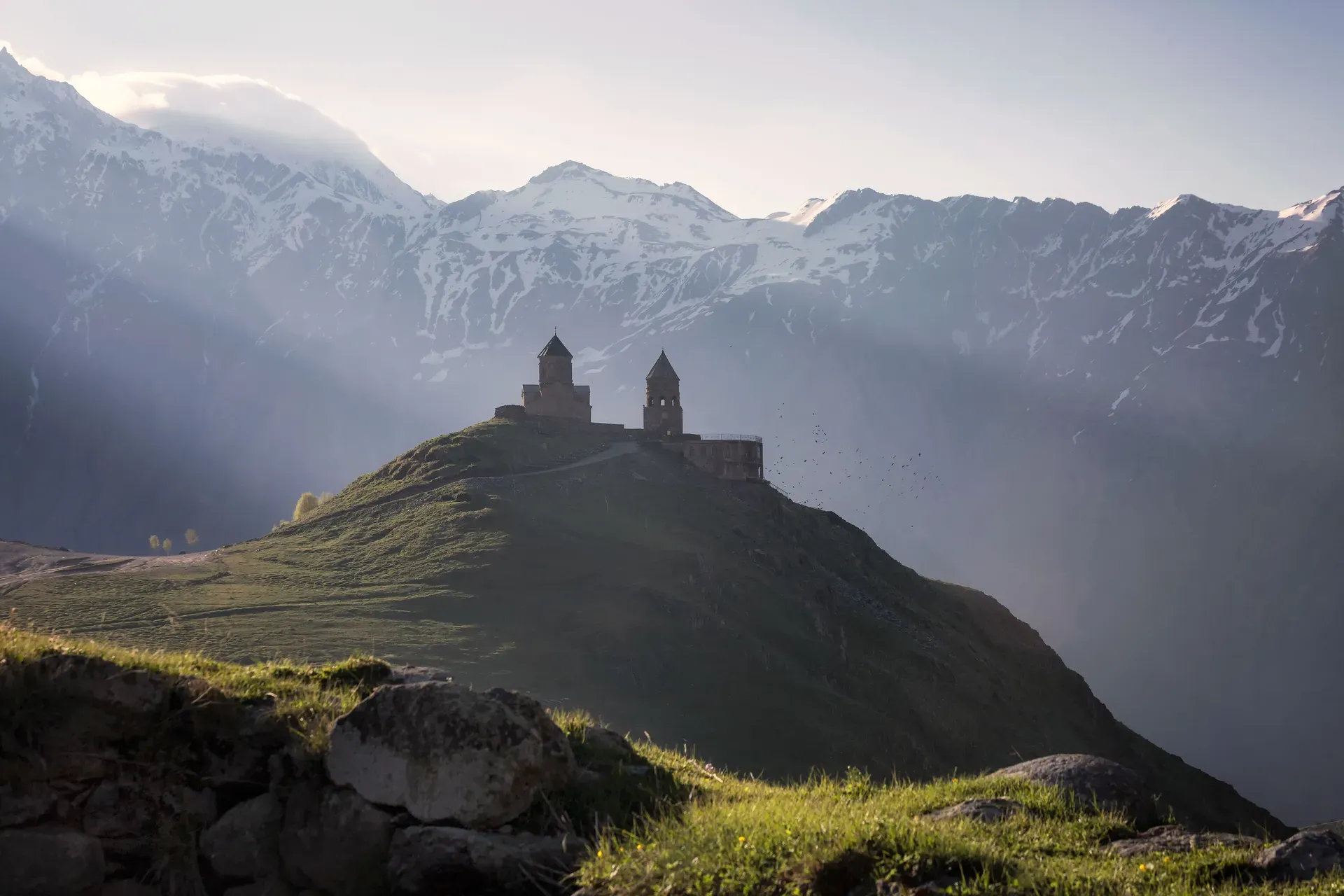
Kazbegi (Stepantsminda) is a mountain town at 1,740 m in northern Georgia, 152 km north of Tbilisi beneath the 5,054 m Mount Kazbek — home of the 14th-century Gergeti Trinity Church and the trails of Kazbegi National Park.
Stepantsminda — Kazbegi to everyone who actually goes there — is a small mountain town at 1,740 m in northern Georgia, 152 km north of Tbilisi on the Georgian Military Highway. The road in crosses the Jvari Pass at 2,379 m and drops into the Terek River valley, where the town sits beneath a 5,054 m dormant volcano. Mount Kazbek fills the northern sky on clear mornings. Most afternoons, it's gone behind cloud.
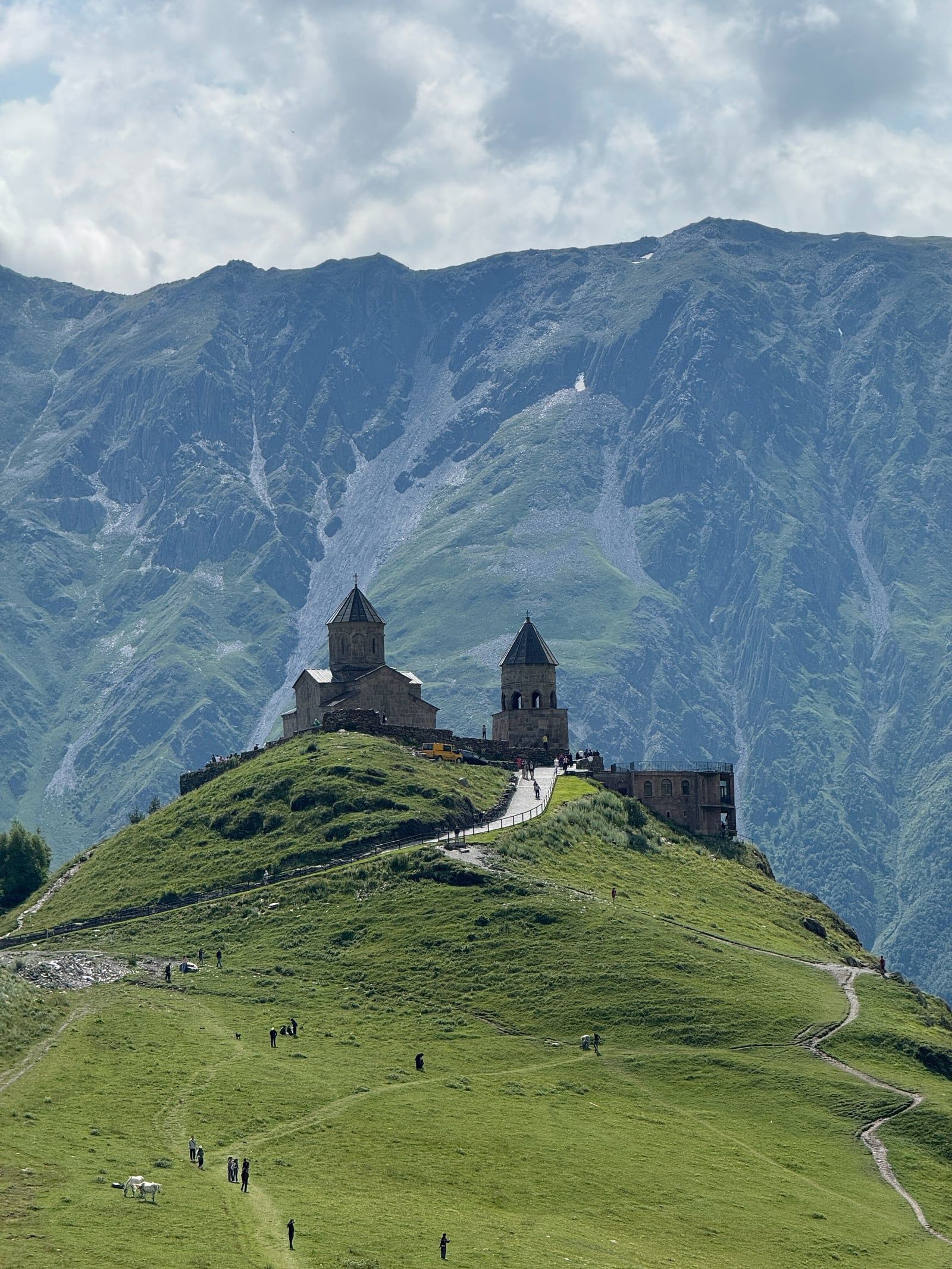
Most visitors come for one photograph: the 14th-century Gergeti Trinity Church standing alone at 2,170 m, 420 m above the rooftops, with Kazbek's snow pyramid lined up behind it. Getting there is half the point. A 3.5 km trail climbs through gardens and open pasture to the churchyard in 60–75 minutes; local 4×4 drivers will bump you up a steep dirt track for about 40 GEL return if you'd rather spare your knees. Go either way before 8 AM. Fog off the peak can swallow the church by late morning and release it again an hour later.
The town itself works as a base, and a well-connected one. Marshrutkas from Tbilisi's Didube station make the run up to 11 times a day (20 GEL, 3–4 hours), private transfers start around 190 GEL, and day tours bundle the drive with Ananuri Fortress and the Friendship Monument on the pass. Kazbegi National Park spreads 78,543 ha around town, with routes to the Gergeti Glacier at 3,200 m, the sawtooth Chaukhi massif above the village of Juta, and the travertine springs of Truso Valley — hikers commonly stay two to four days to fit them in. Summer highs sit near 15°C while Tbilisi bakes at 38°C, so pack a jacket in July. And stay a night if you can: the mountain shows itself most often early, and day-trippers usually arrive after the fog does.
Stepantsminda began with a monk. A Georgian Orthodox hermit named Stephan built a hermitage on this spot, and the settlement that grew up around it took his name — Stepantsminda means 'Saint Stephan'. The location explains why anyone settled a valley this high: this is the corridor between Georgia and the North Caucasus, the route armies, traders and herders have used for millennia, and whoever controlled it could charge for passage.
In the late 18th century, King Erekle II put that arrangement on paper. He appointed Kazi-Beg of the Chopikashvili clan as mouravi of Stepantsminda, a royal official in charge of the tolls on the road north. The clan's power then outlasted the Georgian kingdom itself. When the Russian Empire absorbed eastern Georgia in the early 1800s, Gabriel Chopikashvili backed the new administration, helped suppress a revolt, and was promoted to officer in the Russian Army. His family adopted the surname Kazbegi, and the name gradually moved from the clan to the town.
The most famous of the line was born here in 1848. Alexander Kazbegi, one of Georgia's celebrated 19th-century writers, set his novel Patricide — the story of a mountain outlaw defying a tsarist governor — in the landscape visible from his front door. His birth house on the main street is now the town's history museum: 5 GEL, Tuesday to Sunday, 10:00 to 17:30.
Soviet administrators made the family name official in 1925, when the town became Kazbegi. It held for eight decades, through the highway's years as a freight artery between Russia and the south, until Georgia reverted to Stepantsminda in 2006. Nobody actually switched: locals, marshrutka drivers and nearly every guesthouse sign still say Kazbegi, and the national park kept the name too.
Gergeti Trinity Church predates all of it. Built in the 14th century on the ridge at 2,170 m, it is the only cross-dome church in the historic Khevi province, and it worked as more than a place of worship. The 18th-century chronicler Vakhushti Bagrationi recorded that whenever danger threatened the lowlands, treasures from Mtskheta were carried up the mountain and hidden here — among them the Cross of St Nino. In 2006, the same year the town reclaimed its old name, restorers uncovered a 14th-century fresco of St Nino inside, with inscriptions in Asomtavruli, Georgia's oldest script. Restoration continues, so part of the complex may be wrapped in scaffolding when you visit.
Mount Kazbek is a dormant stratovolcano of 5,054 m — the highest peak in Eastern Georgia, third-highest in the country, and the second-highest volcanic summit in the Caucasus after Elbrus. Its last eruption came around 750 BCE. Ice still caps the summit and feeds the Gergeti Glacier; the standard trek to its edge climbs steep moraine to roughly 3,200 m, a 20 km round trip of 9–12 hours. Climbers bound for the summit itself overnight at the Betlemi Hut at 3,653 m before crossing the glacier.
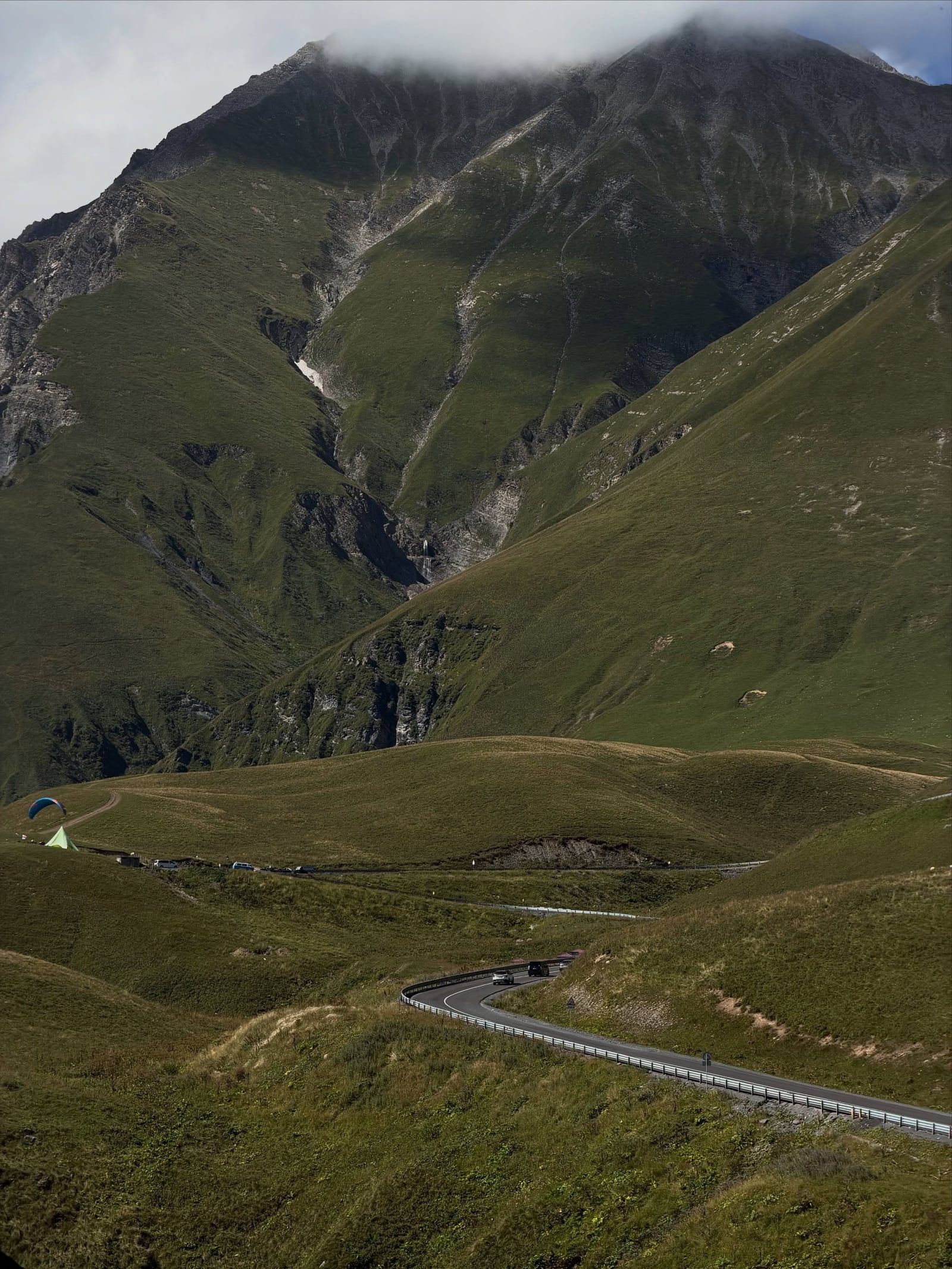
The town occupies the valley floor at 1,740 m, where the Chkheri River, a left tributary, joins the Terek. Gergeti Trinity Church holds the ridge on the Chkheri's right bank, close enough that pilgrims walk up before breakfast. From Tbilisi the road threads past Ananuri and the ski lifts of Gudauri before topping out at the Jvari Pass, 2,379 m — the highest point on the Military Highway, and the section that closes when avalanches run. North of town the walls close in: the Dariali Gorge, one of the two main crossings of the Greater Caucasus since antiquity, squeezes the road through tunnels and galleries past queuing lorries on its way to the Russian border.
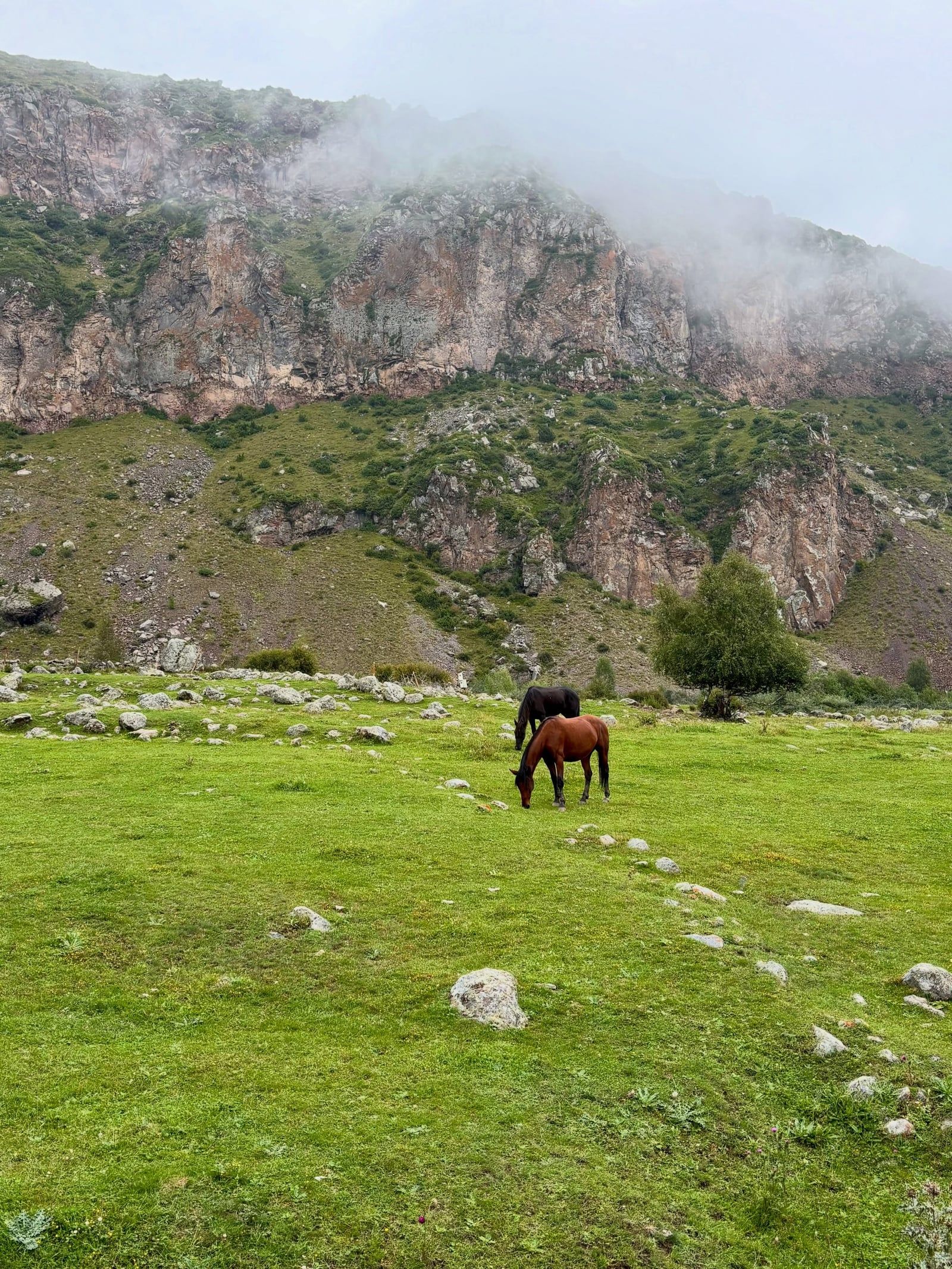
Kazbegi National Park wraps 78,543 ha of mountains around all of this, from a low point of 1,400 m to the ice. Only 35% of the park is forest. The rest is alpine pasture, moraine and bare rock — open country where East Caucasian tur and chamois graze the high slopes, and where weather can flip from sunshine to hail within an hour even in July. Two valleys earn the walk: Truso, with its orange-and-white travertine mineral springs, abandoned villages and the crumbling Zakagori Fortress, and Juta, where the multi-peak Chaukhi massif forms a jagged wall above the trailhead.
For a shorter outing, the Gveleti waterfalls sit in the Dariali Gorge a short drive north. The lower falls are a 20–30 minute rocky walk; the upper cascade adds 40–60 minutes. Pair them with the Dariali Monastery, wedged into the gorge near the border, for an easy half day.
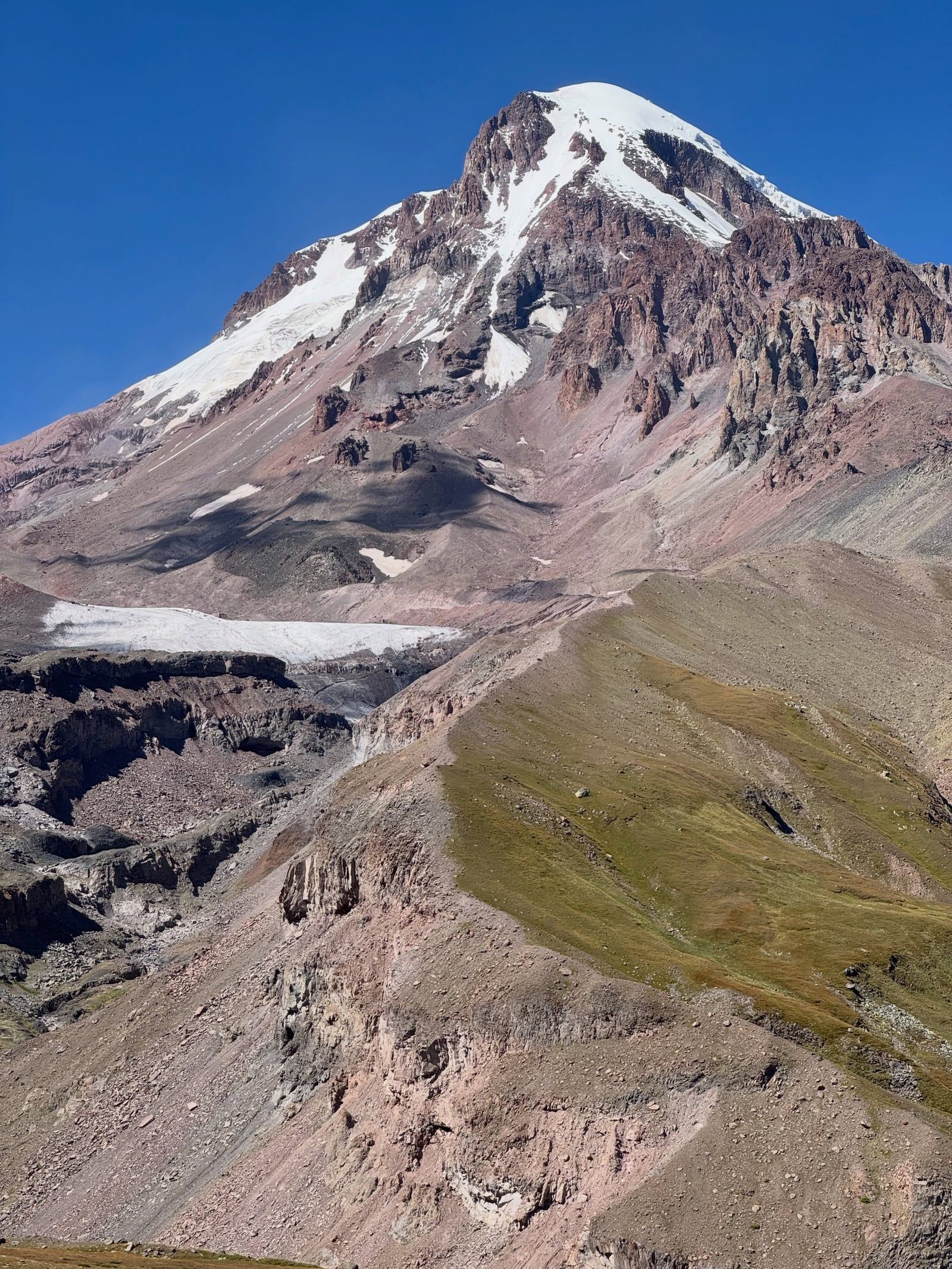
Kazbek has a myth attached to it. Georgian legend tells of Amirani, a hero who stole fire from the gods and, as punishment, was chained to a rock on the mountain — the local ancestor of the Prometheus story, told in these valleys long before the church existed. Mention the peak to a guide on the trail and you'll usually hear the story unprompted.
The church is the living heart of the place. Gergeti Trinity is a working Orthodox monastery, and for centuries it doubled as a mountain vault: whenever raiders threatened the lowland town of Mtskheta, its treasures were carried up the 420 m slope and hidden inside — among them the Cross of St Nino, the cross credited with converting Georgia to Christianity in the 4th century. Pilgrims still make the climb on feast days, some barefoot. The house rules are a working monastery's: women cover head and shoulders (wraps are handed out at the entrance), men wear long trousers and remove hats, and photography inside is forbidden.
For the people of Khevi, the historic province around town, the peak and the church are the two fixed points of local identity. Georgian literature adds a third: Alexander Kazbegi was born in Stepantsminda and set Patricide in these mountains. A young reader named Ioseb Jughashvili admired the novel's outlaw hero and borrowed the character's name — Koba — as his first revolutionary pseudonym; the writer's mountain town gave Joseph Stalin his alias. Photographers have done their part too: Gergeti Trinity is now the most photographed building in the Caucasus, and on a clear sunrise the churchyard railings are lined three deep with tripods.
Mount Kazbek last erupted around 750 BCE. It is the second-highest volcanic summit in the Caucasus after Elbrus, and its ice cap still feeds active glaciers.
The town was officially renamed Kazbegi in 1925 and reverted to its original name, Stepantsminda, in 2006. Almost everyone still calls it Kazbegi.
In dangerous times, treasures from Mtskheta — including the Cross of St Nino — were carried up 420 m and hidden inside Gergeti Trinity Church, according to the 18th-century chronicler Vakhushti Bagrationi.
Restorers uncovered a 14th-century fresco of St Nino with inscriptions in Asomtavruli, Georgia's oldest script — in the same year the town got its old name back.
Only 35% of Kazbegi National Park is forest; the rest is alpine pasture, moraine and rock, home to East Caucasian tur and chamois.
Legend ties the mountain to Amirani, a hero chained to a rock on its slopes by the gods as punishment for stealing fire.
Alexander Kazbegi, born in the town in 1848, wrote Patricide. The young Stalin admired its outlaw hero and borrowed the name Koba as his first revolutionary pseudonym.
Nothing — it's the same town. Soviet authorities renamed it Kazbegi in 1925 after the local Kazbegi family, and Georgia reverted to the original name, Stepantsminda ('Saint Stephan', after the monk who founded a hermitage here), in 2006. Locals, guides and almost all signage still say Kazbegi.
Yes, entry is free and donations are optional; wraps and headscarves are handed out at the entrance. Official hours are 9:00 AM to 5:00 PM daily. Outside those hours the churchyard gates may be locked, but you can still walk the grounds.
You can, but it's tight: the 152 km drive takes 3–3.5 hours each way, so a day tour means 6–8 hours of travel plus stops. Most experienced visitors stay at least one night, because Kazbek is most likely to be visible in early-morning light rather than under midday cloud.
The trail is 3.5 km one-way with 420–500 m of climbing: 60–75 minutes up and about 90 minutes down, doable in trainers. If that's too much, local 4×4 drivers charge around 40 GEL return for the steep, bumpy dirt road — agree the fare before setting off.
Yes, it's a year-round freight route. But the Jvari Pass section at 2,379 m closes temporarily several times each winter due to avalanches — usually for a couple of hours, occasionally for one to three days. Winter tires are compulsory, and the 9.5 km Kobi–Gudauri cable car exists as a backup crossing when the road is blocked.
Bring your passport: Truso lies in Georgia's border zone with Russia and documents are checked at the valley entrance. The main valley needs no advance permit, but going beyond Zakagori Fortress requires a free permit issued at the checkpoint near the Dariali border post, usually within about 30 minutes.
Yes. The classic route starts in Stepantsminda, climbs past Gergeti Trinity Church to the Betlemi Hut at 3,653 m, then crosses the Gergeti Glacier to the 5,054 m summit. It's a serious high-altitude undertaking that demands proper acclimatisation and equipment.
Early. Leave Stepantsminda before about 8:00 AM; photographers favour 7–9 AM for soft light and 5–7 PM for golden hour. The peak often hides in cloud in the afternoon, and conditions change fast — it's cold and windy at the church even on warm days.
About 20 km return from town via the church, climbing steep moraine to roughly 3,200 m beneath Kazbek's icefalls. It takes 9–12 hours round trip and is rated hard — the ascent from the church is unrelenting.
It's a working Orthodox monastery. Women must cover head, shoulders and knees (a skirt or dress to at least the knee); men need long trousers and must remove hats. Free wraps are provided at the entrance, and photography inside is banned. Bring a warm, windproof layer regardless of season.
Browse verified tours with free cancellation and instant confirmation.
Find Tours