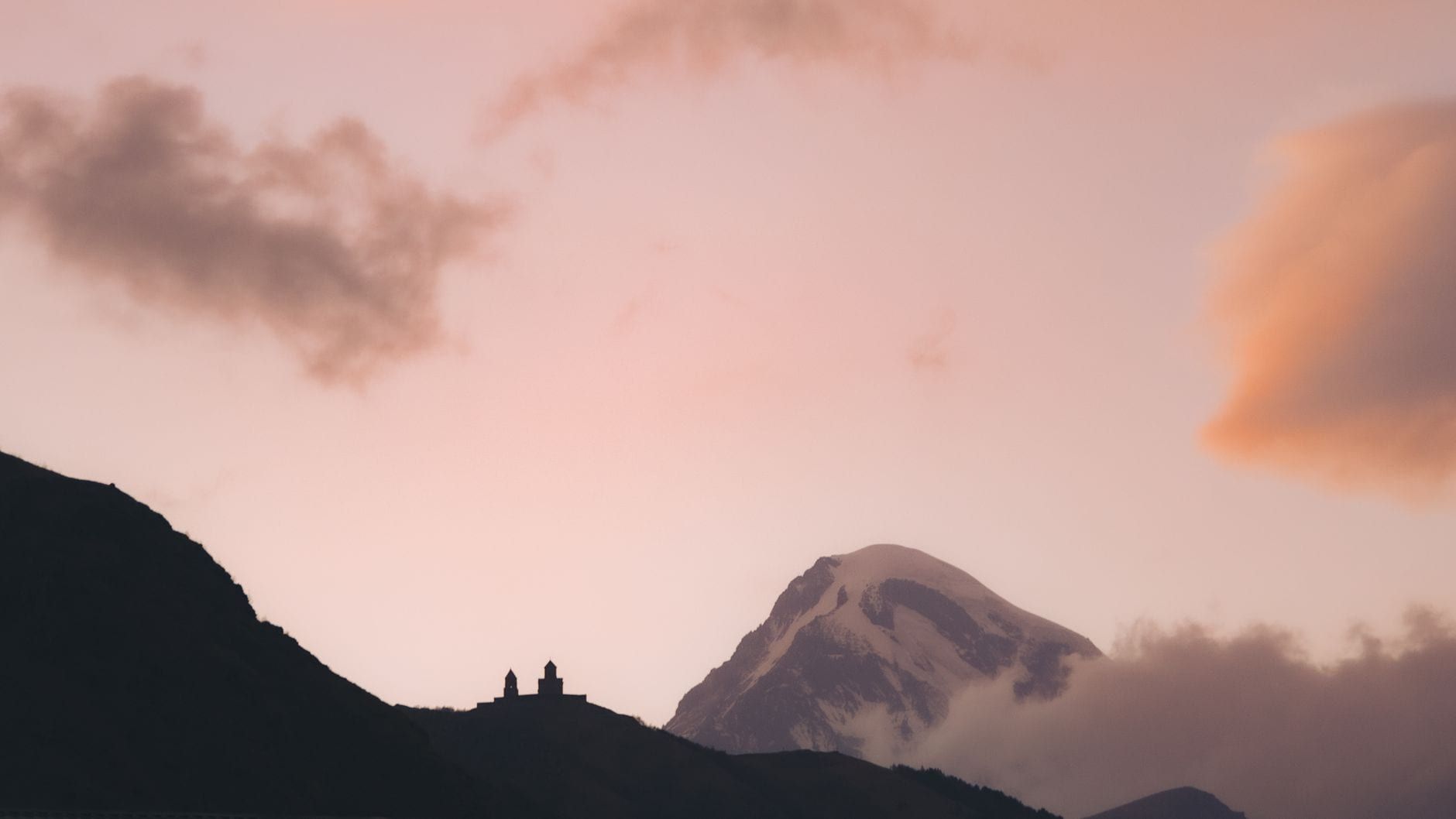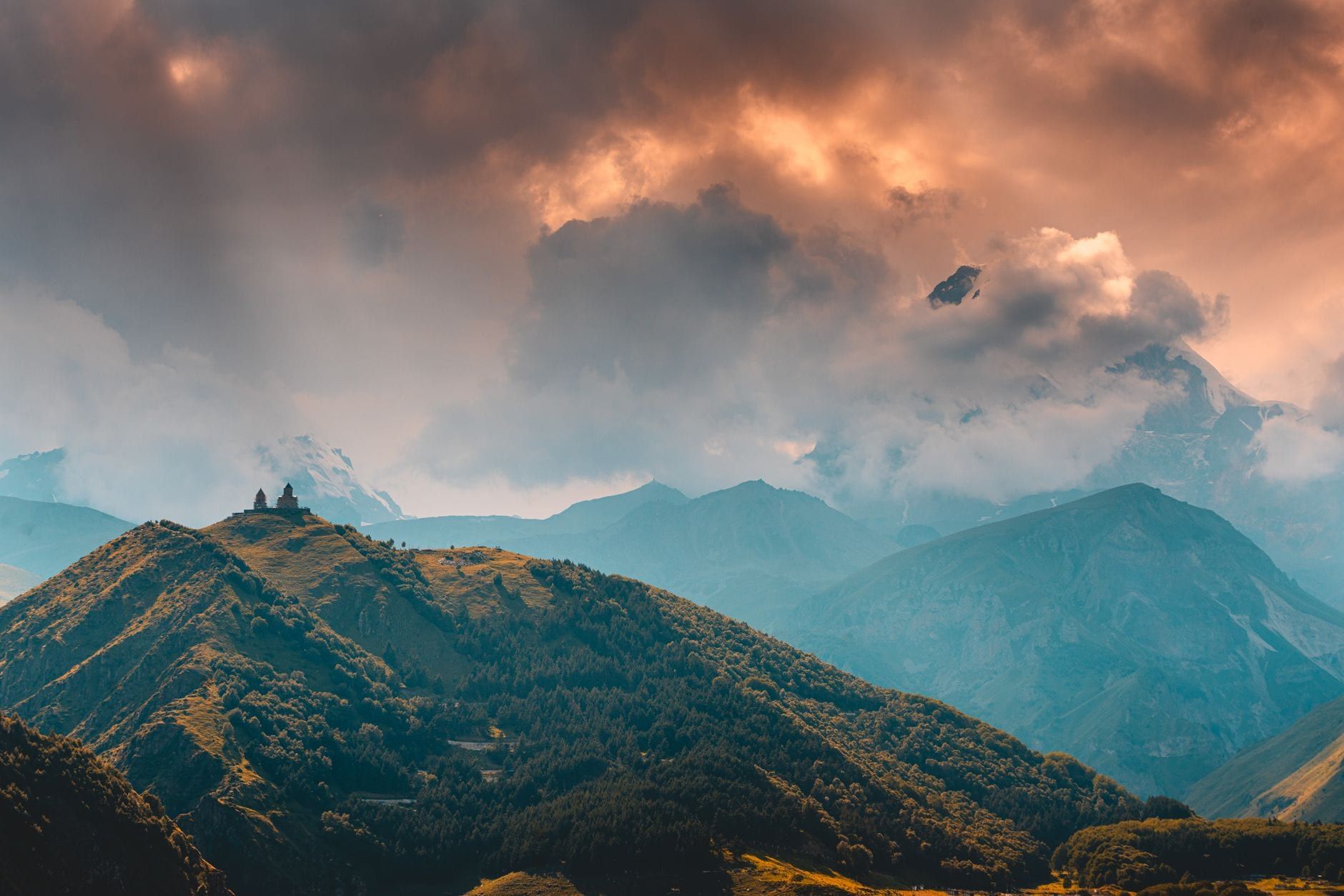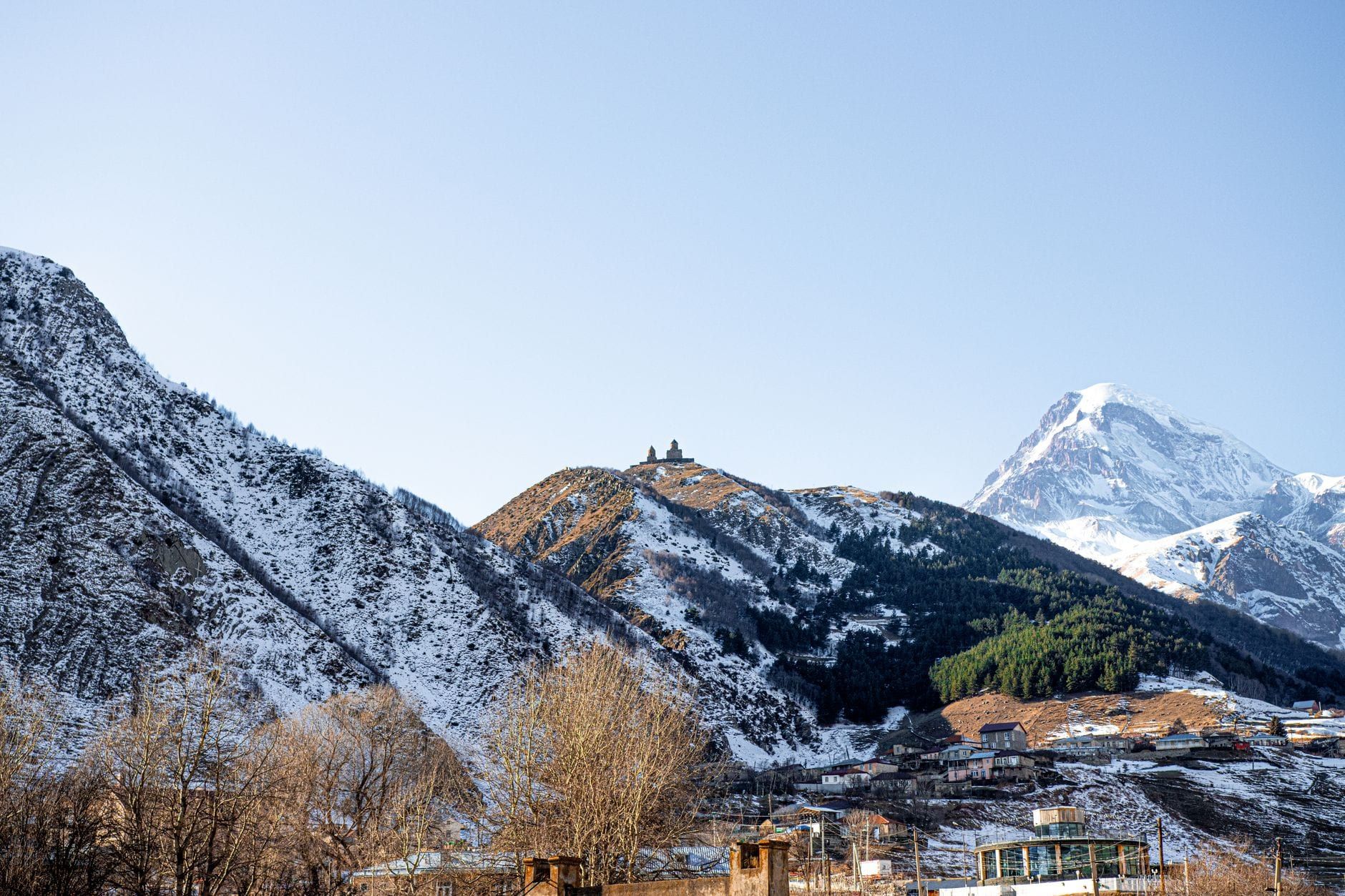
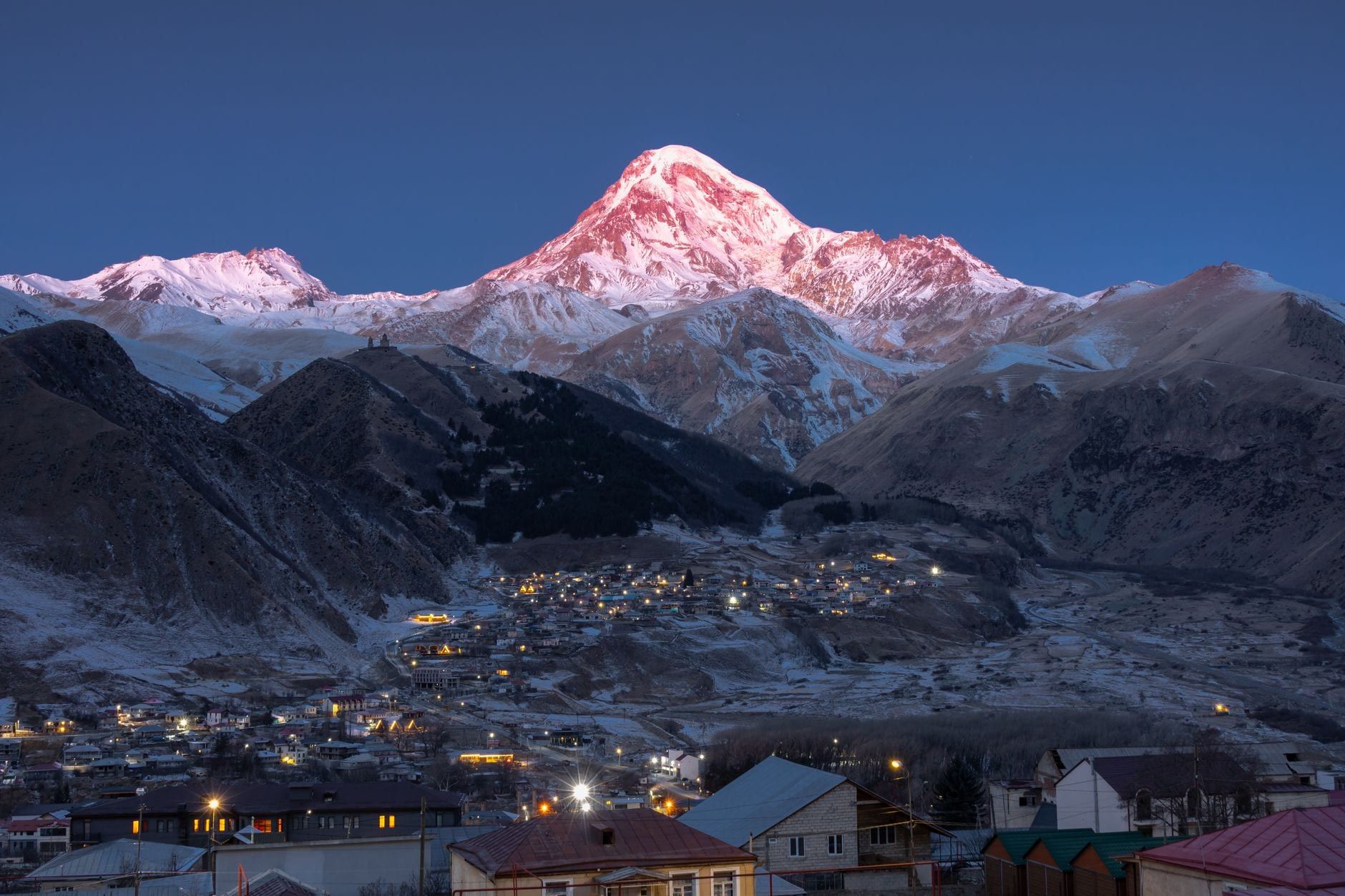
Mount Kazbek is a 5,054 m dormant stratovolcano on the Russian border, and climbing it is the most serious thing you can do above the town of Stepantsminda. The normal route starts at Gergeti Trinity Church (2,170 m), crosses the Gergeti Glacier, and finishes on a roped no-fall slope about 150 m below the summit. There are no rock pitches and no steep ice walls — but this is a glacier climb, and treating it as a hike is how attempts end badly.
This guide covers the whole decision: what the route involves stage by stage, a day-by-day itinerary you can copy, what it costs, the border-zone paperwork most guides gloss over, and how to judge whether you're ready. Georgians call the mountain Mkinvartsveri — glacier peak — which is the more honest name.
What Kind of Climb Is Mount Kazbek? (And Is It Right for You?)
Kazbek stands 5,054 m (16,581 ft) above Stepantsminda — the highest peak in eastern Georgia and the second-highest volcanic summit in the Caucasus after Elbrus. Ignore the old 5,033 m figure still quoted in places; the surveyed height is 5,054 m. The last eruption was around 750 BCE, and the volcano now wears its history as ice: the Gergeti Glacier spills from the summit slopes toward the church below.
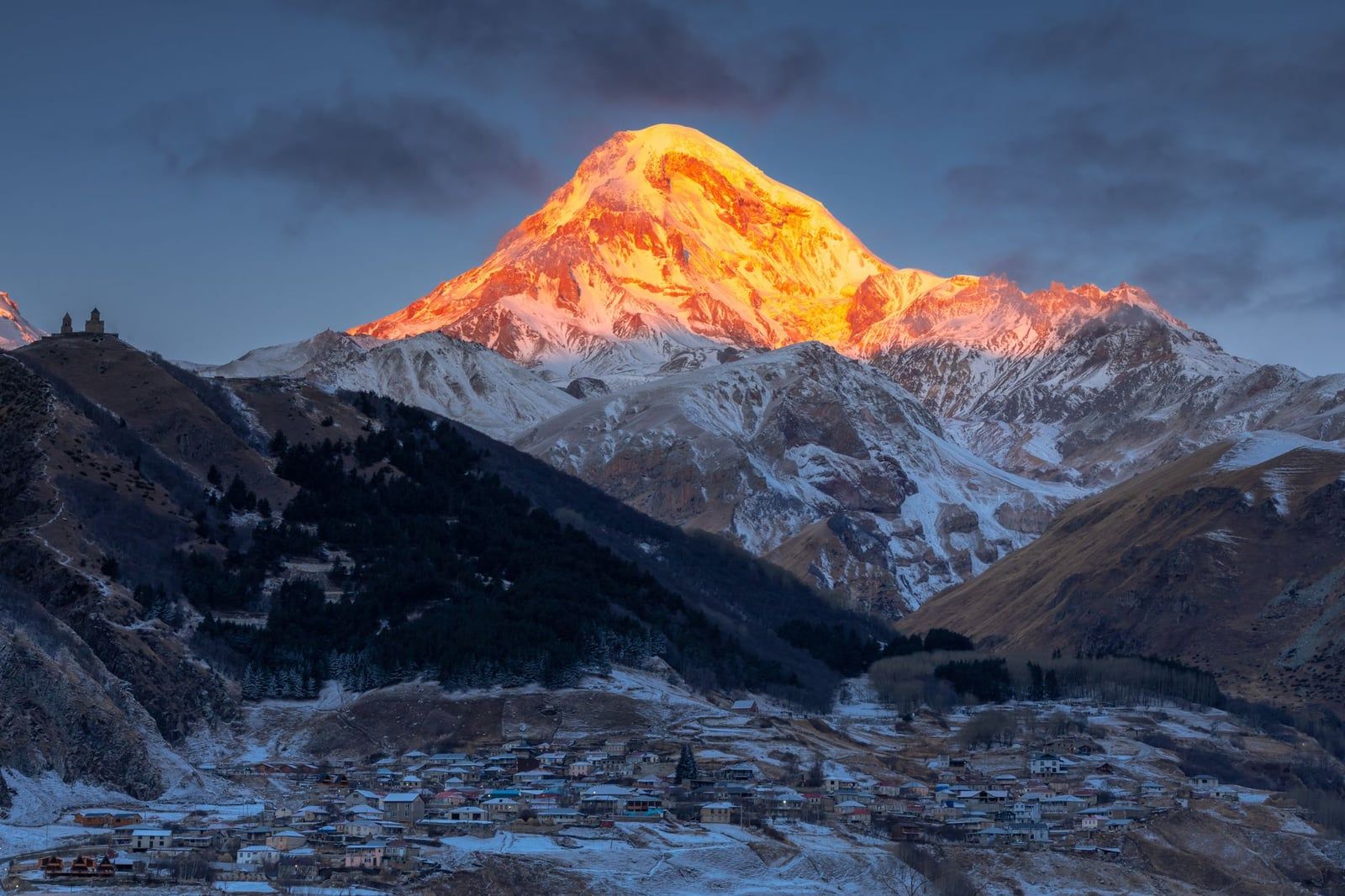
The normal route is graded PD on the alpine scale — mountaineering, but at the easy end of it. You walk glacier, cross snow bridges, and near the top negotiate roughly 100 m of easy ice at no more than 40 degrees. The final ~150 m slope is different: a no-fall zone where you move roped to your guide, because a slip there doesn't stop on its own. "Non-technical" on Kazbek still means mountaineering.
Who it suits: a fit trekker with some crampon hours looking for a classic first 5,000 m peak. Who should wait: anyone who has never slept above 3,500 m, never walked in crampons, or can't comfortably manage a ten-hour day with 1,500 m of gain. There are no official summit statistics, but operators agree most turnarounds trace to altitude, fitness or weather — not terrain.
Do you need a guide? Georgia's official tourism guidance is plain: experienced mountaineers may climb unassisted; climbers with limited experience should hire a professional. Operators cap teams at roughly one guide per three roped climbers. Travelling alone — women included — a guided group is the standard way to do the mountain, and it bundles in the border-zone paperwork. Start with the guided hiking tours run from Stepantsminda and compare ratios and inclusions.
When to Climb Mount Kazbek: Season, Weather and Windows
Late June to mid-October is the broad window for the classic route; the core season runs from the beginning of June to the end of September, when the line is at its least technical. Within that, the months trade stability against crowds:
- June: more snow on the route — best for conditioned climbers.
- July–August: the most stable weather, long days, busiest huts.
- September: thinner crowds, colder mornings — go in the first half.
- Late March to end of May: the separate ski-mountaineering season.
Winter is a different mountain. Combined readings of -15°C and winds around 100 km/h make the open glacier genuinely dangerous, and experienced operators simply don't take clients then. Even the drive in gets serious: the Jvari Pass at 2,379 m closes temporarily for avalanche control several times each winter. We cover the cold months separately in our guide to Kazbegi in winter.
Caucasus weather builds fast. A wisp of cloud at dawn can be a whiteout on the plateau by ten, and forecasts for a 5,000 m summit are educated guesses. So plan windows, not dates: build a reserve day into every itinerary and be genuinely willing to use it.
The Normal Route via Gergeti Glacier, Stage by Stage
One line runs from Stepantsminda to the summit, and every climber on it works through the same sequence: walk in, acclimatise, cross the glacier, climb the headwall. Here is the altitude profile.
| Stage | Altitude | What it's like |
|---|---|---|
| Stepantsminda → Gergeti Trinity | 1,740 → 2,170 m | Trail or 4x4 track through pasture; the warm-up |
| Gergeti → Altihut | 2,170 → 3,014 m | About 5 km and 3–4 hours; meadow onto moraine |
| Altihut → Betlemi Hut | 3,014 → 3,653 m | Rough moraine and rock; the mountain starts here |
| Betlemi → the glacier | 3,653 → ~4,000 m | Rockfall couloir, then ice; crampons and rope go on |
| Glacier → plateau | ~4,000 → 4,400 m | Roped travel; crevasses and snow bridges |
| Plateau → summit | 4,400 → 5,054 m | The saddle, then the ~150 m roped final slope |
Two spots deserve particular respect. The couloir between Betlemi Hut and the glacier funnels rockfall — you cross it early, quickly, and with your helmet on. Higher up, crevasses hide under snow bridges that weaken as the day warms, which is a large part of why summit days start at 2 a.m. The bergschrund below the summit slopes opens and shifts with the seasons and can force a short detour.
As for kit: you can stay on rock to roughly the middle of the lower glacier and up to about 4,000 m, where the upper glacier begins. There, crampons and ice axe stop being optional, and roped travel starts around 3,900 m.
There is no Everest-style fixed-rope system on Kazbek. The protection is your team's rope — you cross the glacier as a roped group, and on the final slope you move one at a time while the guide holds the line. A guide may rig a short situational line near the bergschrund or on the summit pitch in icy conditions, but nothing permanent exists.
Other lines exist — a direct route on the mountain, and approaches from the Russian side — but they are steeper, quieter and worse protected. For almost everyone, the normal route via the Gergeti Glacier is the only realistic line.
A Sample 4-Day Itinerary (and When to Add Days)
Four days is the practical minimum, and this is the itinerary most guided trips run. Some squeeze it into three; don't. Door to door, with travel and a weather day, the realistic trip length is about a week to a week and a half.
Day 1: Stepantsminda to Altihut
Climb out of town to Gergeti Trinity Church at 2,170 m — our Gergeti Trinity Church guide covers the trail in detail — then continue roughly 5 km to Altihut at 3,014 m. Expect 3–4 hours; one operator logs it as 7 km in three. It's pasture, then moraine, and it exists for one purpose: sleeping at 3,014 m instead of in the valley. Take it slow. Rushing day one is a tax you pay on day three.
Day 2: skills school and the move to Betlemi
The morning is for practice: crampon technique, ice-axe arrest, roped walking on a snow patch above the hut. In the afternoon you climb rough moraine and rock to Betlemi Hut at 3,653 m. If the team feels good and the weather holds, an out-and-back to the small chapel at about 3,900 m is the classic climb-high-sleep-low move — go up, come back, sleep at Betlemi.
Day 3: the summit push
Alarm between 1 and 3 a.m., depending on your guide's read on the snow bridges. Headtorches on, you cross the couloir while it's still frozen, rope up around 3,900 m, and grind the glacier to the plateau at 4,400 m. Then the saddle, then the roped final slope. The summit typically arrives late morning — 7–8 hours up from Betlemi and 10–12 hours round trip, stretching to 15 for slower teams. You sleep at Betlemi or drop to Altihut; nobody descends to town the same day.
Day 4: the walk out
The descent is the part people underestimate. You're tired, the snow bridges have been softening since mid-morning, and the couloir that was frozen solid at 3 a.m. is now shedding stone. Leave early and don't switch off until you're off the moraine. Then it's a few hours back past the church to Stepantsminda, a shower, and a very large dinner.
When to add days: if you live at sea level, reaching Betlemi within 48 hours of landing in Tbilisi is aggressive, and a fifth or sixth day spent acclimatising measurably improves your odds. Some expeditions run seven or eight days, sleeping high before the push. Whatever the length, keep one full reserve day for weather — and never book a flight the morning after summit day.
Training and Acclimatisation: Where Kazbek Is Won or Lost
The fitness benchmark is simple: can you walk ten-plus hours with around 1,500 m of gain, on mixed terrain, and function the next morning? If not, train for it — long hill days with a weighted pack, weekly, for two to three months before you fly. On the mountain, pacing beats power: a guide setting a metronome-slow pace up the glacier is doing it right.
Above Betlemi at 3,653 m, everything costs more. Steps feel steeper, appetite drops, sleep fragments. That's normal altitude, not failure. What isn't normal: a headache that won't shift, nausea, vomiting, loss of coordination. A tent staffed by medical volunteers at Betlemi can check you for AMS — use it. If symptoms persist or worsen, descending is the only correct response, and every hour of delay makes it harder.
Operators follow the guideline of no more than about 800 m of sleeping gain per day — impossible to respect above Betlemi, which is why staged itineraries succeed more often than fast ones. Beyond that: drink far more than feels necessary, and add electrolytes or minerals, because melted glacier water is mineral-free and quietly washes yours out. Eat small, frequent, carb-rich meals. Walk slower than you think you need to.
- Rushing acclimatisation to save a hut night.
- Summit fixation — treating the top as the goal.
- Going unroped on the glacier "just for a bit".
Decide your turnaround triggers before summit day, with your guide, at Betlemi:
- AMS symptoms worsening despite rest or painkillers.
- Weather closing in — cloud, wind or spindrift on the plateau.
- Route deteriorating: soft bridges, open crevasses, rockfall in the couloir.
- Pace slipping past your agreed turnaround time.
- The team breaking down — one sick member ends the climb.
The summit is a milestone; the goal is getting down. That line is old in mountaineering for a reason: on Kazbek, the descent through warming snow and the rockfall couloir is the most dangerous part of the trip.
Gear Checklist: Bring It, Rent It or Rely on the Guide
Summit mornings in July run around -10°C with wind on top. Dress in three layers — wicking base, insulating mid, hard shell outer — with no cotton anywhere; sweat-soaked cotton at altitude is a hypothermia risk. Add thin liner gloves under insulated shells, a warm hat, and serious sun protection, because glacier sun burns through thin air and off the snow from both sides.
Boots decide the climb. You need stiff-soled, crampon-compatible mountaineering boots, broken in before you get on the plane — a blister at 4,000 m is a summit-ending problem. Lightweight trekking shoes and a casual rain jacket are not adequate for the glaciated upper mountain.
The hardware — crampons, harness, two carabiners, a 120 cm sling, helmet, ice screws, ice axe — is usually provided on guided trips; confirm in writing what your operator carries before you pack. Renting in Stepantsminda is possible, but availability and quality vary, so inspect anything you rent (points, straps, buckles) before money changes hands. Learn every piece of it at the day-two skills session, not on the glacier.
Carry offline maps, a headlamp with spare batteries (you'll start in the dark) and a power bank — cold kills phones fast, and there's no charging worth the name above Altihut. Water purification matters too: potable water is scarce on the route, and you'll be refilling from snowmelt.
Huts, Costs and Budget
Where you sleep shapes the climb. Stepantsminda's guesthouses are the comfortable base; above them, three huts do different jobs.
| Place | Altitude | What you get |
|---|---|---|
| Stepantsminda guesthouses | 1,740 m | Hot showers, proper dinners, Wi-Fi; arrival and recovery base |
| Deka Hut | 3,020 m | Built in 2024, 28 beds, staffed May–October; the newest option |
| Altihut | 3,014 m | Lodging and a restaurant at tree line; the standard first night |
| Betlemi Hut | 3,653 m | The traditional high base — basic, busy, and where summit days begin |
Betlemi costs about 60 GEL (~€20) a night, with camping outside the hut at around 20 GEL (~€7). There are no porters on Kazbek — gear travels by horse, at roughly €100 one way to Betlemi, and splitting it between two climbers makes it reasonable. Local outfits offering horse riding tours and transfers can arrange the carry.
Guided climbs run from about €500 per person in a group of three to €1,100 solo with operators like the Alpine Project; small-group trips cluster at €500–750, and listings span €500–1,500 by group size, with recent solo private formats reaching €1,630–1,830. Transfers, hut fees and gear are the usual exclusions — compare private tours and group packages line by line, not by headline price.
Doing it yourself, the line items are: Tbilisi–Stepantsminda transport both ways, hut or camping fees for two or three nights, food and stove gas, plus any rental gear. An experienced team can climb Kazbek for well under the guided price; the savings buy the risk you now manage alone. Either way, buy insurance that explicitly covers mountaineering above 5,000 m, glacier travel and evacuation — standard travel policies exclude all three.
Permits, Safety and Getting There
Kazbek sits in Georgia's border zone with Russia, and climbing it requires Border Police authorization: individuals or legal entities apply with the permit application and passport documentation. In practice, guides handle this for their clients; if you're climbing independently, it's on you, so start the paperwork before you leave home. There is no separate climbing fee. On arrival, the whole group registers with the Betlemi Hut administration — it takes minutes, and it's how rescuers would know to look for you.
Georgia's unified emergency number is 112, staffed 24/7 for police, fire and medical. On the mountain, medical volunteers are based at Betlemi in season. Helicopter evacuation exists but is private, arranged by guides, and entirely weather-dependent — assume that in a whiteout you are self-rescuing, and pack rope, first-aid kit and a team accordingly.
Magti is the only network with service at Betlemi, and it's slow. Above the hut there is nothing — not on the plateau, not on the summit. Sort your plans at the hut, tell someone below your route and timings, and don't count on texting for help.
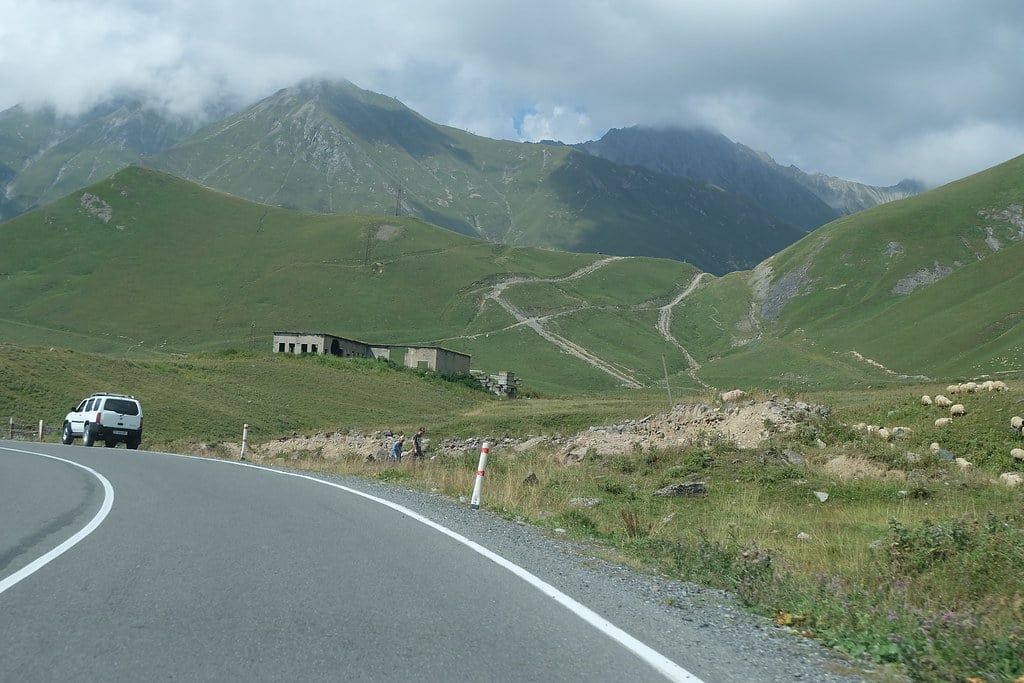
Tbilisi to Stepantsminda is about 150 km and three hours up the Georgian Military Highway. Marshrutkas leave Didube station for 20 GEL, with around 11 departures daily; a private transfer runs from roughly 190–300 GEL per car — our guide to how to get to Kazbegi covers the options in full. From town, the climb starts at Gergeti Trinity Church, and a 4x4 saves the hour's walk up for around 40 GEL return.
Build buffer into the end of the trip. If weather eats your reserve day you'll be glad of a spare night in Stepantsminda, and the valley's lower walks are covered in our roundup of things to do in Kazbegi. Never book an international flight for the morning after summit day — delayed teams miss flights.
Frequently asked questions
How hard is it to climb Mount Kazbek?
Technically moderate (PD) — no rock or steep-ice pitches — but a real glacier climb: crevasses, ~1,400 m of summit-day gain and 5,054 m of altitude make the 10–12-hour day the crux. A feasible first 5,000er with training and, ideally, a guide.
How many days does the Kazbek climb take?
The standard mountain itinerary is 4 days (some manage 3; add a weather-reserve day for 5). With travel and acclimatisation, plan about a week to a week and a half door to door.
Do you need a permit to climb Kazbek?
There's no separate climbing fee, but Kazbek sits in a border zone: apply to Georgia's Border Police for authorization with passport documents (guides often handle it), and register the whole group at the Betlemi Hut administration on arrival.
How much does it cost to climb Mount Kazbek?
Guided climbs run roughly €500–1,500 per person depending on group size, with private packages up to around €1,830. DIY costs are mainly the hut (~60 GEL/night, camping ~20 GEL) and, optionally, a horse for gear (~€100 one way).
When is the best time to climb Mount Kazbek?
Late June to September, with July–August the most stable and September quieter but colder; June often holds more snow. A ski-mountaineering season runs from late March to end of May; winter ascents are for experts only.
Can you climb Mount Kazbek without a guide?
Yes, if your team already owns roped glacier travel and crevasse-rescue skills — the glacier is the skill gate. For everyone else a certified guide is strongly recommended, at a typical maximum ratio of one guide to three climbers.
Are there fixed ropes on Mount Kazbek?
No permanent fixed-line system exists: protection on the glacier is your team's rope. A guide may rig a short situational line on the final ~150 m slope in icy conditions.
How high can you go on Kazbek without crampons?
Rocks are walkable to roughly the middle of the lower glacier and up to about 4,000 m. Crampons, ice axe and harness become necessary at the upper glacier edge, with roped travel from around 3,900 m.