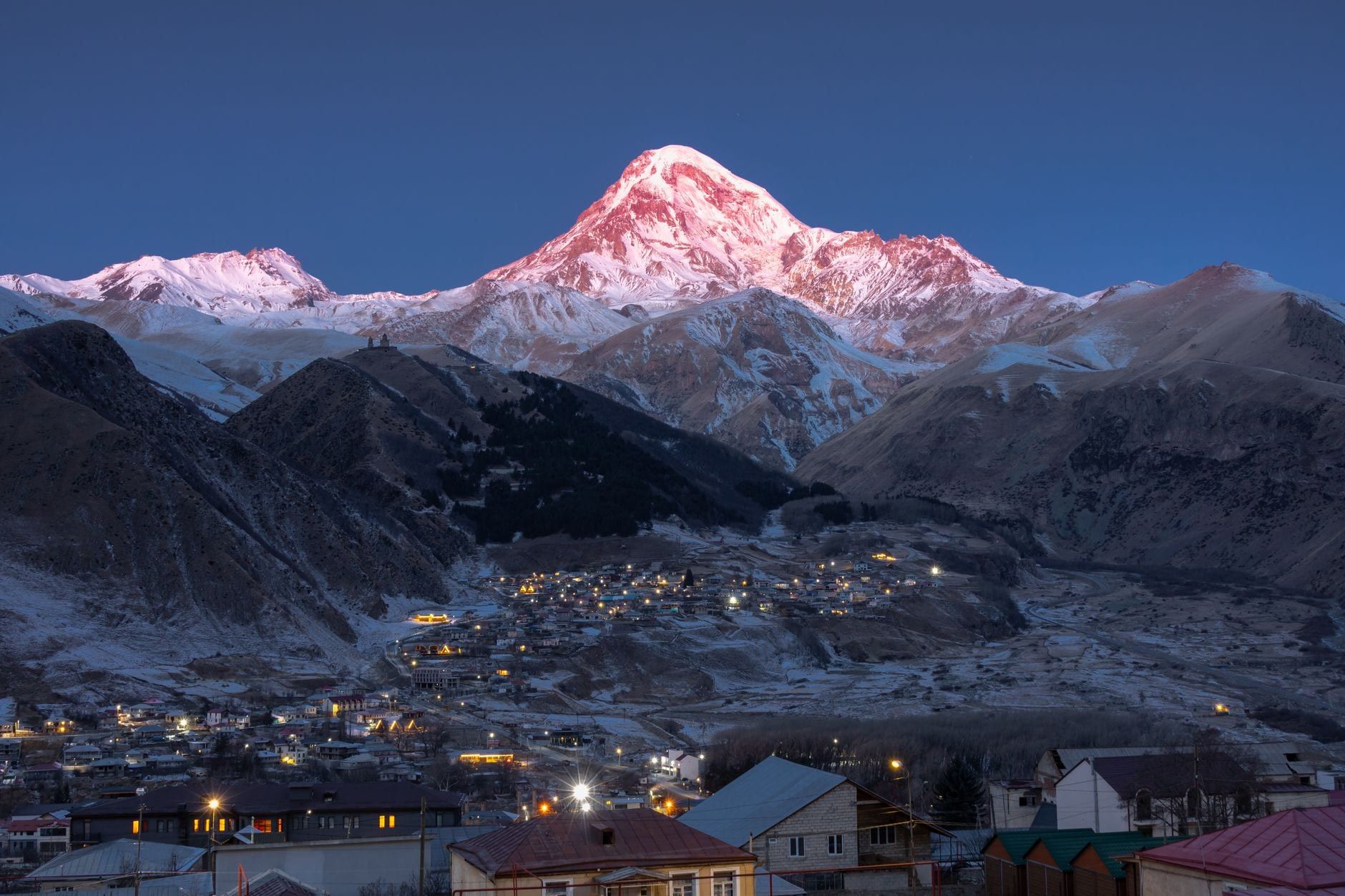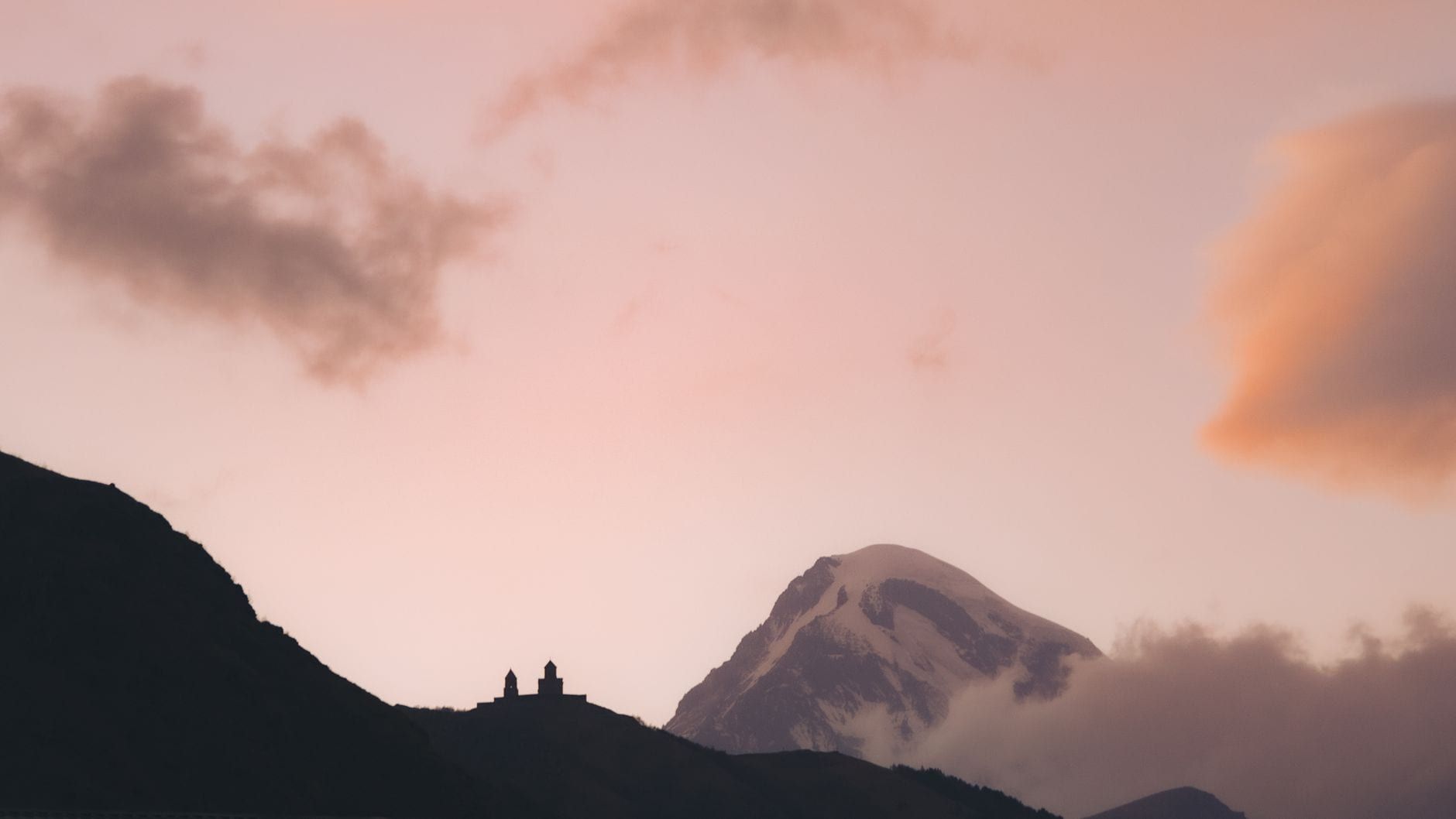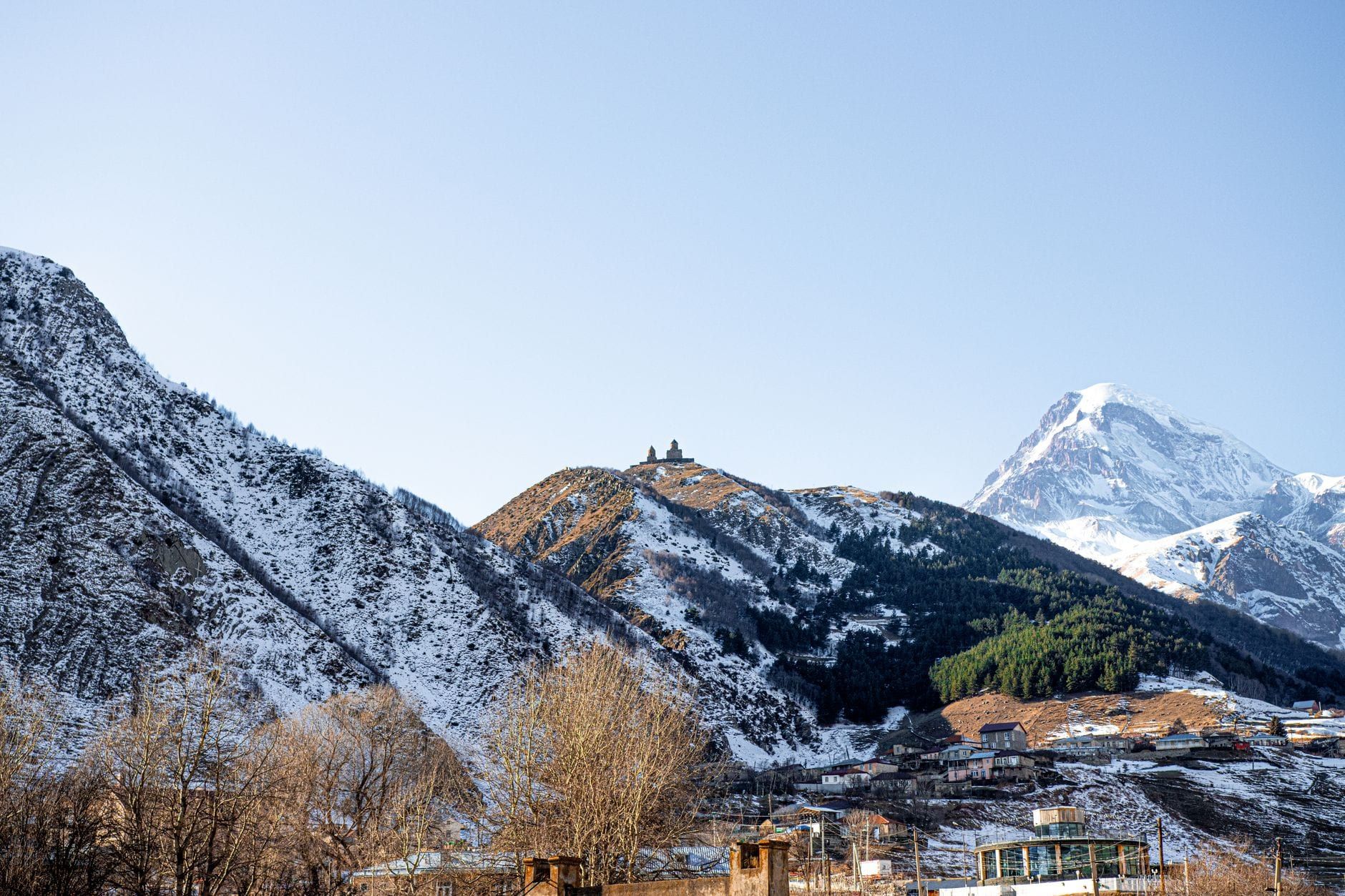
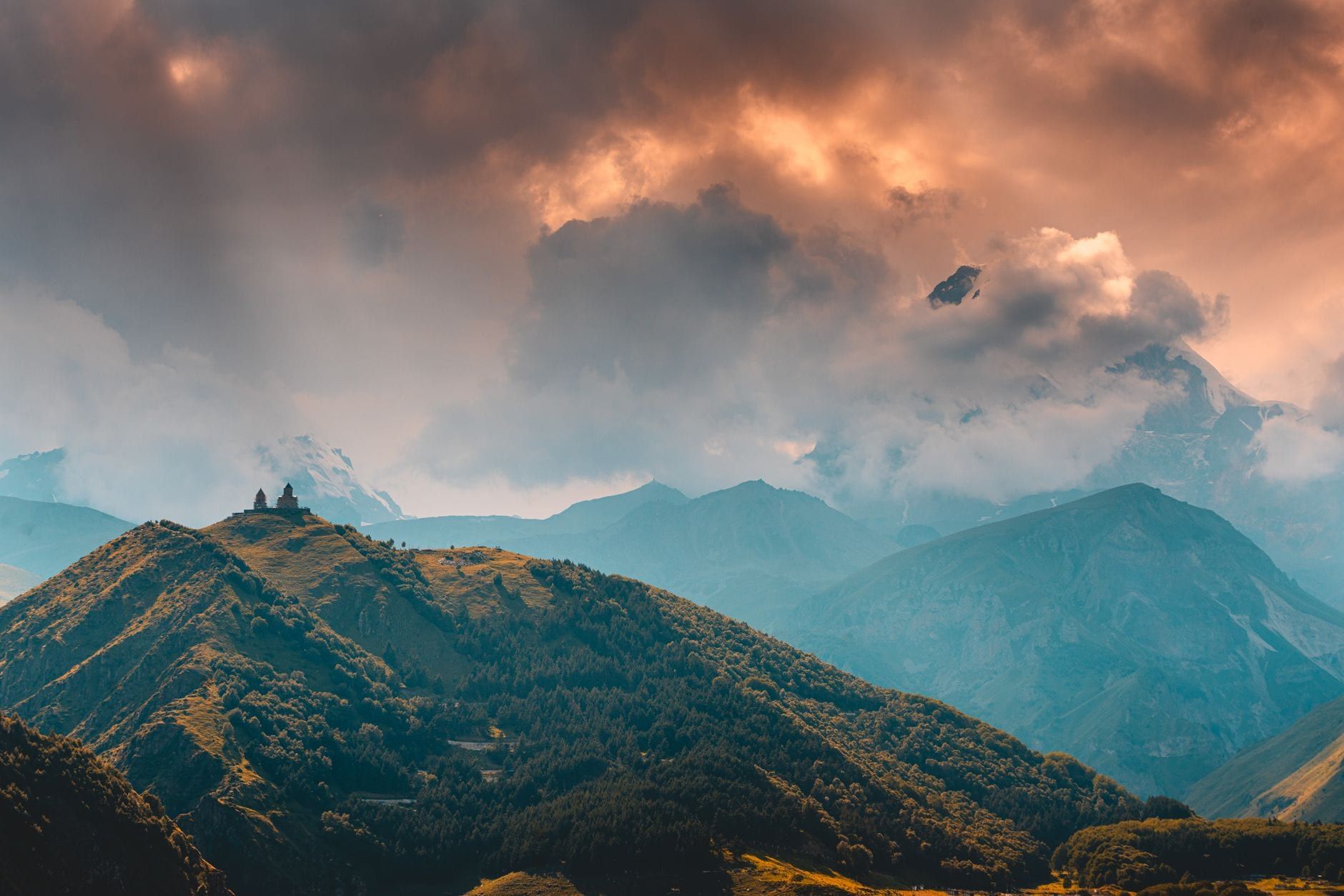
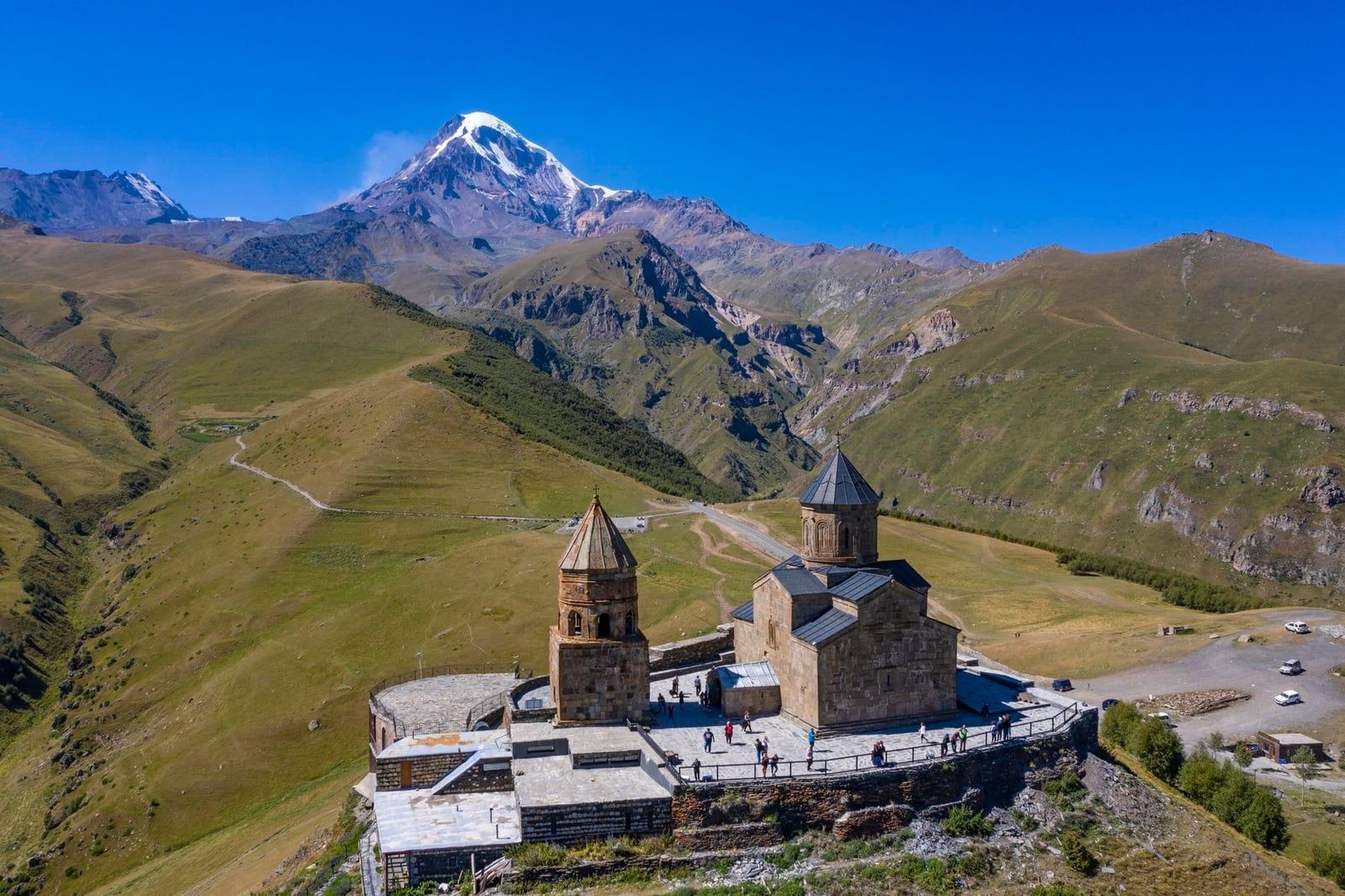
A lone stone church on a green ridge, a 5,054 m volcano rising behind it — that's Gergeti Trinity Church, the image most people have of Georgia before they can find the country on a map. The church stands at 2,170 m on the right bank of the Chkheri River, roughly 420 m above the town of Stepantsminda and directly below Mount Kazbek. Everything about visiting it involves a choice: walk up, ride up, drive up, or let a tour handle it.
This guide covers all of it — the history, the hours, the dress code, prices in lari, the trail turn by turn, and the cloud problem that decides whether you get the postcard or a white wall.
What Is Gergeti Trinity Church and Why Is It Famous?
Gergeti Trinity Church — Tsminda Sameba in Georgian — is a 14th-century stone church with a separate bell tower added later in the same century. It's the only cross-cupola church in Khevi, the historic highland province around Stepantsminda, and its isolation is the whole point: nothing else stands on that ridge, so the building reads as a silhouette against the Caucasus rather than a monument in a town.
Its position made it useful, too. When invasions swept the lowlands, treasures from Mtskheta — including the Cross of Saint Nino, Georgia's most important relic — were carried up and hidden in the fortified complex, according to the 18th-century chronicler Vakhushti Bagrationi. A 14th-century fresco of Saint Nino was rediscovered here as recently as 2006. Under Soviet rule the church was closed and used for storage, then reconsecrated after independence; today it's a working monastery, and parts of it have been wrapped in restoration scaffolding in recent years, so check locally before you count on a clean photograph.
One naming note before the logistics. The town below is officially Stepantsminda; it was renamed Kazbegi in 1925, under the Soviets, and reverted in 2006. Everyone still says Kazbegi. If you want the town's wider story — the monk Stephan, the toll-collecting Kazbegi family, the writer born here — our guide to Kazbegi's history covers it.
Gergeti Trinity Church: Key Facts at a Glance
Here's the whole practical picture in one place. The details behind each line follow in the sections below.
| Question | Answer |
|---|---|
| Elevation | 2,170 m — about 420 m above Stepantsminda (town at ~1,740 m) |
| Entry fee | Free; no ticket office, donations optional |
| Opening hours | Gates 9:00–17:00 daily; churchyard and viewpoints accessible outside hours |
| Dress code | Women: covered head and shoulders, skirt or wrap; men: long trousers, no hats |
| Photography | Fine outside; prohibited inside; no drones at the site |
| Time needed | 20–30 minutes by 4x4, 60–90 minutes if you walk |
Facilities at the top are basic but real: free toilets, a small candle shop, mountain-spring water refill points, and a snack van in summer. There's no food shop, so hikers should carry what they need.
Getting to Kazbegi (Stepantsminda) from Tbilisi
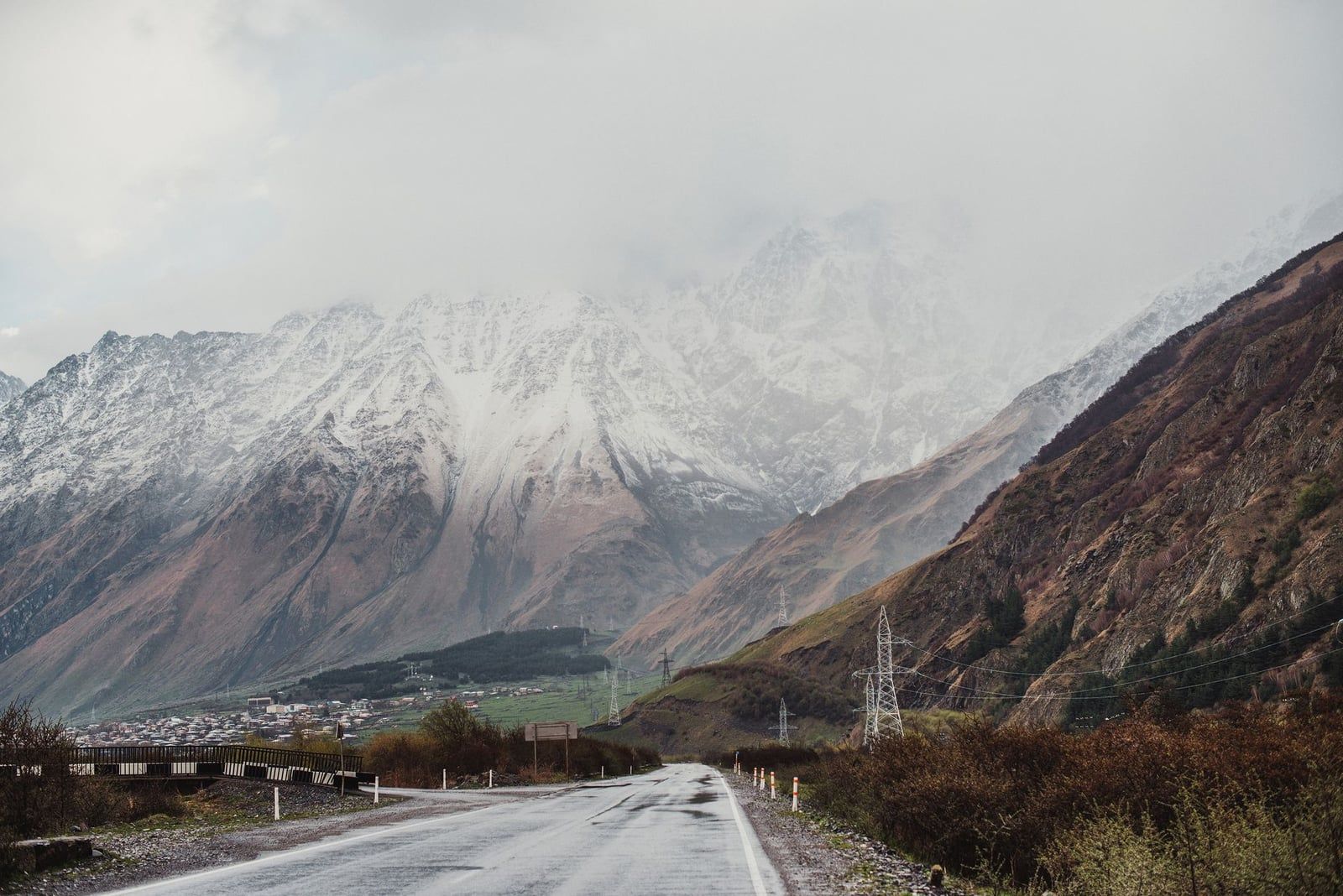
Stepantsminda is about 152 km north of Tbilisi along the Georgian Military Highway, crossing the Jvari Pass at 2,379 m on the way — a drive of 3 to 3.5 hours without stops. Full transport detail is in our guide to getting to Kazbegi; the short version follows.
The cheap option is the marshrutka: minivans leave Didube bus station when full — 11 departures daily, morning to late afternoon — for 20 GEL per person and roughly 3–4 hours on the road. Arrive 30–45 minutes early to get a seat, and don't expect much luggage space. A private transfer via GoTrip starts around 190 GEL per car and lets you stop wherever you like along the highway; the drivers fit winter tires in the cold season and child seats are free.
Organized day tours from Tbilisi run from about US$25–59 per adult and typically include Ananuri Fortress, the Russia–Georgia Friendship Monument and a 4x4 shuttle to the church. Read the fine print: some operators add the church taxi as a separate ~20 GEL cash extra, because full-size tour buses can't make the road up. You can compare Kazbegi day tours to see exactly what each one includes.
Day trip or overnight? A day trip gives you roughly 45–60 minutes at the church, arriving with every other bus in the midday window when Kazbek is most likely to be cloud-capped. Sleeping in Stepantsminda gets you the mountain at dawn and a second chance if the first morning fails. More on that below.
Getting Up from Stepantsminda: Hike, 4x4, Drive or Tour
Four ways stand between you and the church, and the right one depends mostly on your knees, your budget and your departure time.
| Option | Time (one way) | Cost | Effort | Best for |
|---|---|---|---|---|
| Hike | 60–75 min | Free | Moderate — ~500 m of climbing | Anyone with half a day and decent shoes |
| Shared 4x4 (Delica) | 15–20 min | ~40 GEL return per car | None | Tight schedules, bad weather, sore knees |
| Self-drive | 15–20 min | Fuel only | Easy but steep driving | Independent travellers with a suitable car |
| Day tour from Tbilisi | Full day | From ~US$25–59 | None | Visitors without transport or time to plan |
Shared 4x4. Mitsubishi Delica drivers wait around the edge of town and at the base of the road; fares run about 40 GEL return for the car, with tours quoting ~20 GEL one-way, and 30–60 minutes of waiting at the top is usually folded in. Agree both the wait time and the return fare before you get in — the price is negotiated, not metered. One quirk worth knowing: drivers charge about the same for a one-way as for a return, which is what makes the hybrid below so efficient.
Self-drive. The road is now sealed asphalt and open to ordinary cars — the dirt-track warnings in older guides are out of date — but it's a relentless series of hairpins, and the small parking area at the top fills by mid-morning in summer. Descend in first or second gear and ride the brakes as little as possible. Two cautions: check your rental contract first, because Georgian agreements often void insurance on mountain roads, and skip the drive entirely on snow or ice.
The hybrid: walk up, ride down. You earn the unfolding views on the climb and spare your knees on the descent, all for the same fare as a round-trip taxi. That's the one to book if you're wavering. There's also a small scene of local operators who'll take you on horseback, which suits riders more than walkers but is otherwise a niche choice.
The Hike from Kazbegi: Trail Guide
The walk is about 7 km return with 420–500 m of climbing: 60–75 minutes up, around 90 down, or 3.5–4 hours door to door with time at the top. It's a genuine trail rather than a road walk, and the single most common mistake happens in the first twenty minutes.
Finding the trailhead and the fork. From the centre of Stepantsminda, cross the river and follow Gergeti Street past Red Stone Guest House to Cafe Gergeti, where the track begins. Shortly after, the path splits in two — take the left fork, the one keeping the stream on your left as it climbs the valley. That's the gentler, better-graded route, and it approaches the church from the south with the classic view opening in front of you. Most people who go wrong here take the right-hand path or the road, and pay for it in steepness. You'll pass a Mokhevian stone tower on the way up — a reliable sign you're on the stream path.
The climb. It starts gently through meadows and pasture where livestock graze, then pitches up for a steep final push through open ground with sections of loose rock. Poles help on the way down if you have them. The whole route faces the Terek valley behind you, so the view improves with every switchback — a fair trade for the effort.
The descent. Reversing the stream path is the standard answer. Two alternatives exist: a stepped path with blue signs, built in 2021 behind the carpark at the top, which is the fastest way down but has been washed out and repaired before, and the older forest route — longer, stonier and viewless, but a useful fallback when the valley path is wet or snow-covered.
Altitude and kit. At 2,170 m the air is thin enough to notice if you've flown in from sea level — you'll be breathless on the steep sections, not endangered. Walk slowly, drink more than you think you need, and expect the church plateau to be cold even when the valley is warm. Trainers are fine in dry weather; bring a windproof layer and at least a litre of water plus snacks, because there's nothing to buy up there beyond a summer snack van. In snow conditions the trodden valley path stays passable with proper winter gear, but if you'd need to borrow that gear, take the 4x4 instead.
Stray dogs sometimes adopt walkers for part of the climb. They're usually harmless, and they usually turn back before the top.
Visiting the Church: Rules, Dress Code & What to Expect
The dress code is enforced at the gate, not politely suggested. Women need covered shoulders and head, with a long skirt or a wrap worn over trousers; men need long trousers and must remove hats. Blue loaner wraps sit at the entrance, but they run out on busy afternoons — carry your own scarf and the whole checkpoint takes ten seconds. It's a working monastery: services take precedence over visiting, some areas are cordoned, and quiet voices are the norm.
Inside, the church is small and very dim, its framed icons lit by candlelight. Photography and video are prohibited — signs make this unambiguous — and there's nothing wrong with standing in the doorway for a minute while your eyes adjust. The separate bell tower forms part of the fortified entrance, which explains how this complex doubled as a refuge for the treasures of Mtskheta.
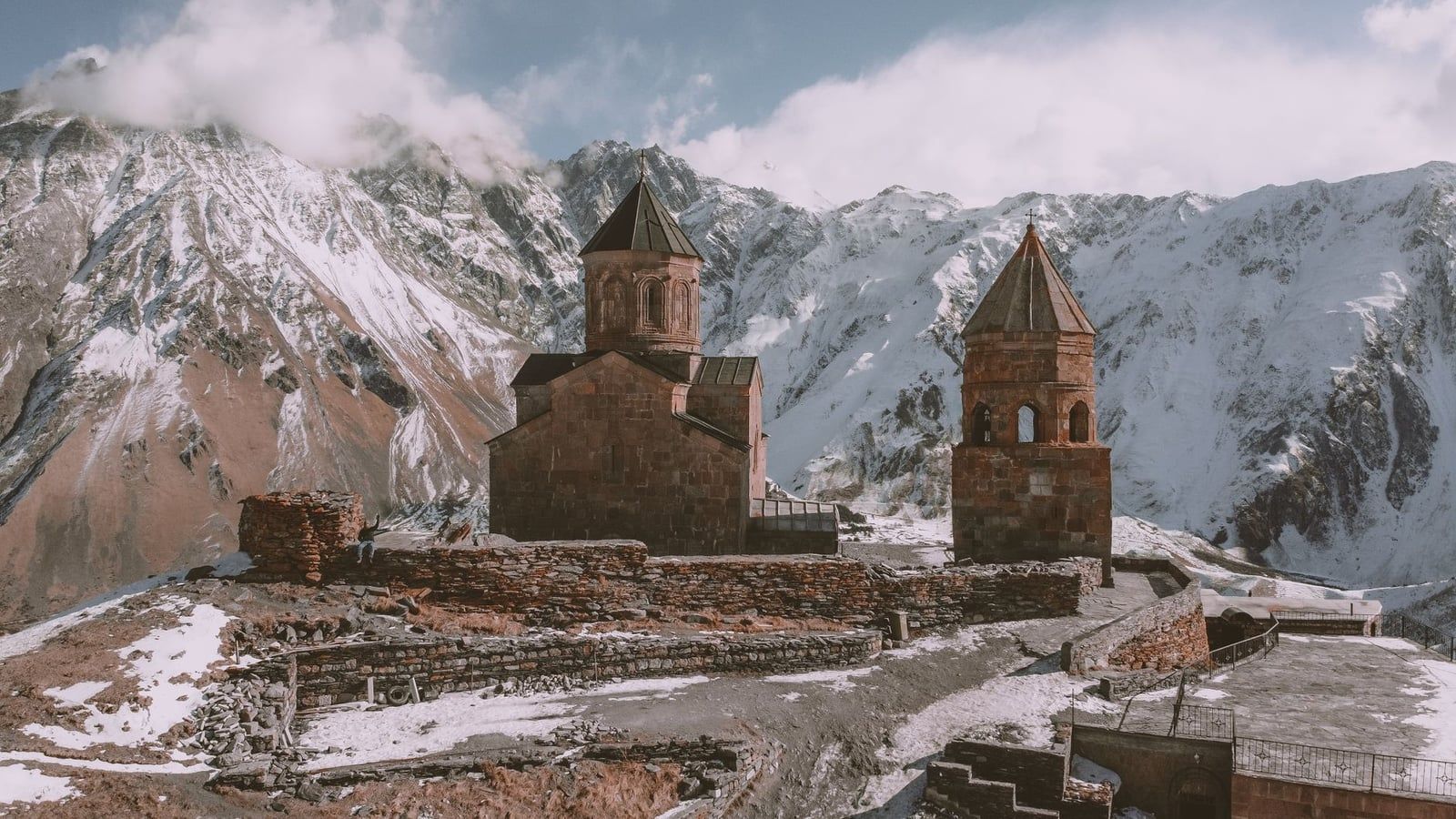
Outside, two things surprise people. First, the cold: the plateau takes the full force of winds coming off Kazbek's glaciers, so a 28°C afternoon in the valley means numb fingers at the church, even in August. Second, the crowds: tour groups arrive from around 10 a.m., and by late morning the gate area can feel like a queue. Visitors by taxi typically stay 20–30 minutes; walkers linger 60–90. Sunset visits are possible and often empty — just plan the descent so you're off the steep sections before dark.
The Best Views of Gergeti Trinity Church
The church faces east, so morning light does the work: by mid-morning the sun sits almost directly overhead and the scene goes flat. Plan your photography before you plan your transport.
The two marked viewpoints. Just beyond the carpark at the top, two signposted viewpoints give the standard church-and-mountain frames with no walking to speak of. They fill first — worth knowing if you want people-free shots.
The west ridge detour. The most famous composition looks at the church from the west with the Kuro massif stacked behind it. Getting it means a 30-minute round-trip walk up the ridge trail that Kazbek climbers use, starting from the big carpark. It's the single best photo decision you can make up there.
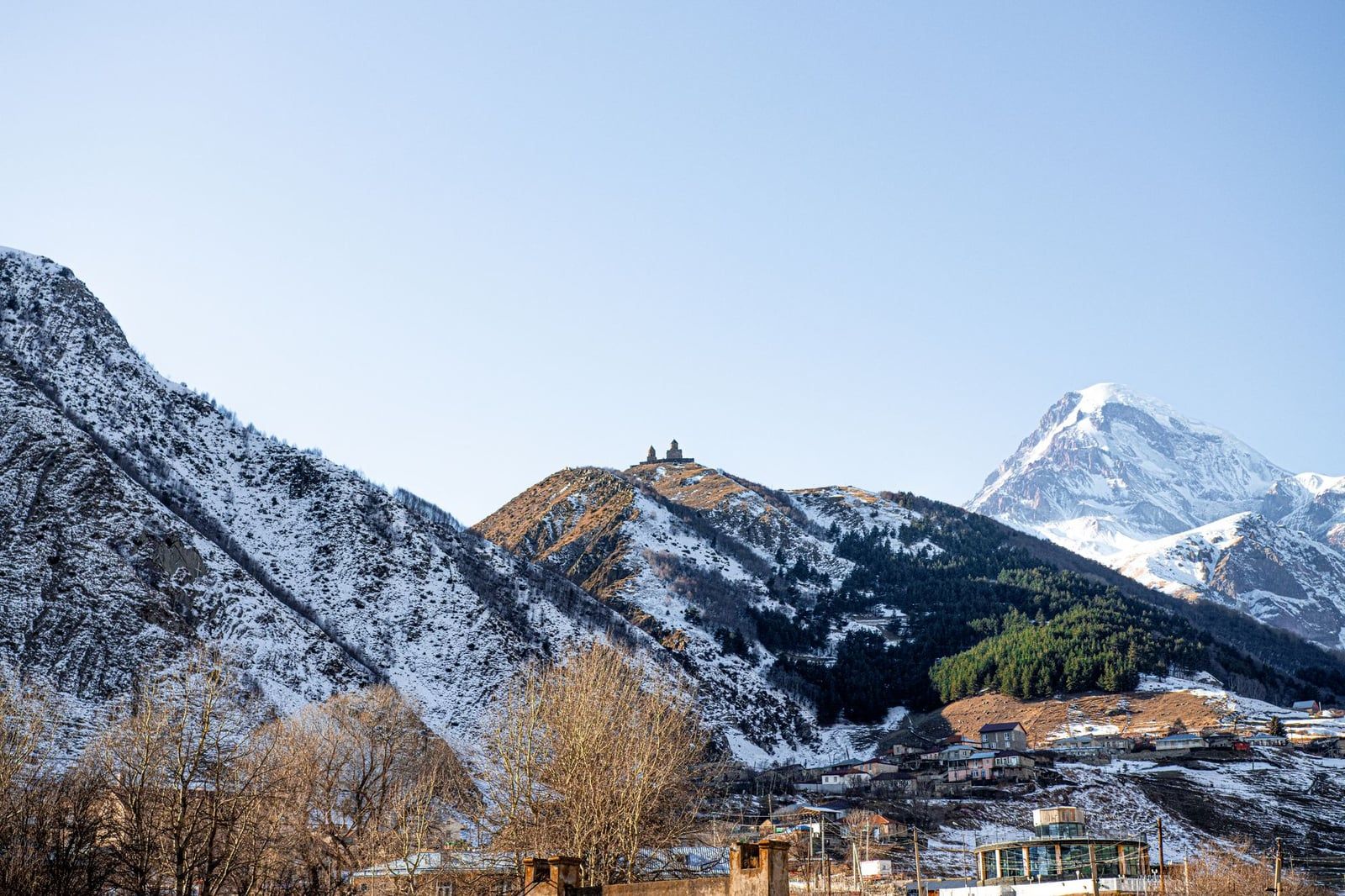
The east meadow and from town. From the meadow east of the church, Mount Kazbek sits directly behind the dome — the alignment everyone photographs from below is even better from here. A small hill just south of the church gives an elevated tower-versus-mountain frame away from the crowd. And if you never go up at all, the ridge-line church is visible from Stepantsminda itself, including from hotel terraces on the south side of town. One reminder: drones are prohibited at the site, so the aerial shot isn't yours to take.
Best Time to Visit (and the Kazbek Cloud Problem)
Here's the part most guides bury: Kazbek's 5,054 m summit is hidden by cloud more often than not, and the cap builds as the valley warms — often by 10 or 11 a.m., reliably by early afternoon. Fog can swallow the church itself in minutes and hand it back an hour later. This is why day-trippers from Tbilisi so often stand at the top staring at white.
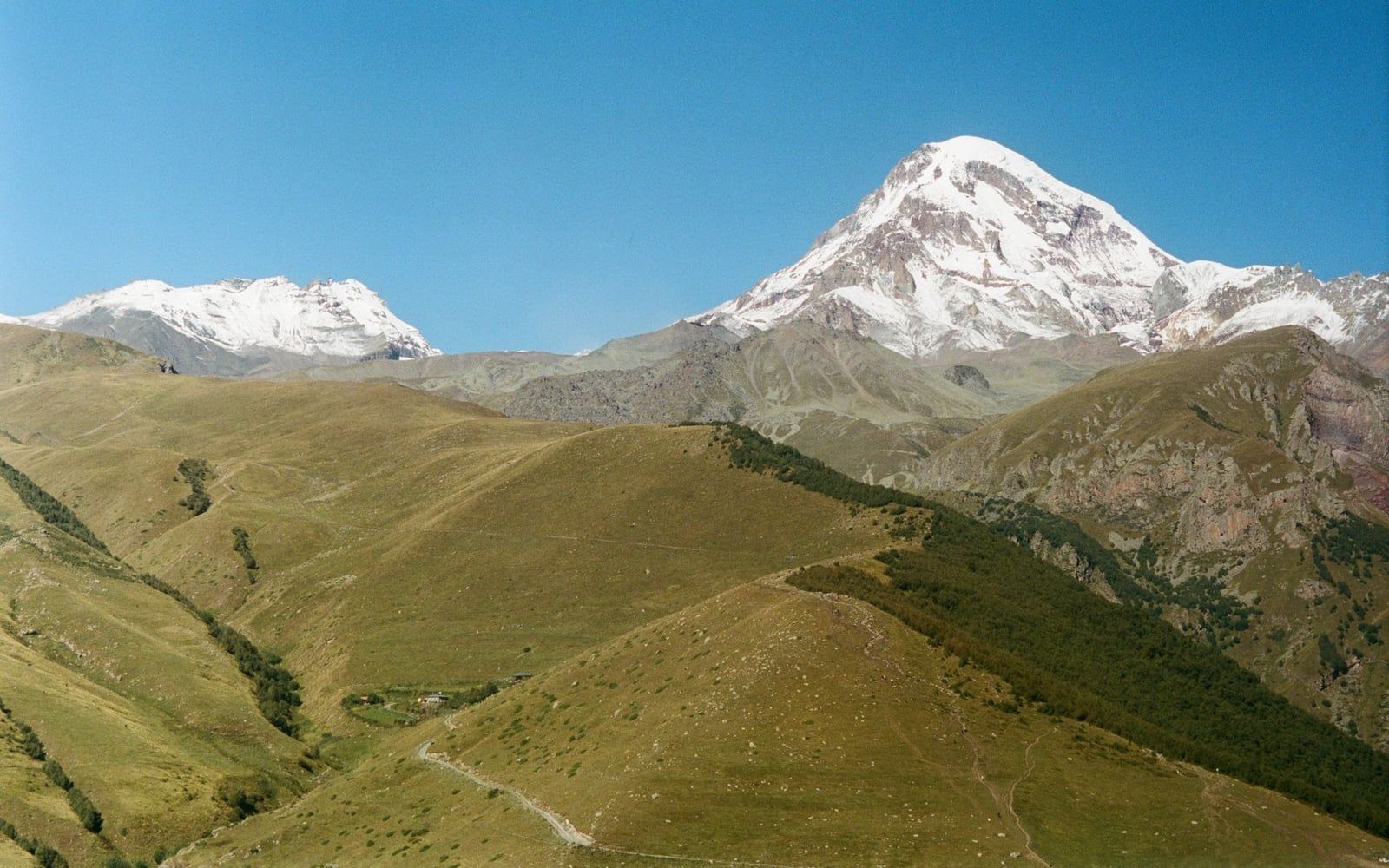
The working rule is simple. Check the summit from the town square at 8 a.m.; if it's already capped, it isn't clearing today — take the van, keep the visit short, and enjoy the church on its own terms. If it's clear, drop whatever you're doing. Early mornings also buy you the shaded trail, empty viewpoints and the day's best light before the tour buses arrive.
By month: November to February brings snow, ice and fog, with avalanche closures on the Jvari Pass several times each winter. March and April are dry but brown, with mud on the trails. May and June are green and flowery but the rainiest stretch. July and August are warm, with wildflowers and regular afternoon thunderstorms — get up and down before the sky turns. September and October are the connoisseur's months: cool, dry, and quiet. For the full cold-season picture, including the road-closure reality, see our guide to Kazbegi in winter.
Winter visits are possible year-round in principle, but the trail becomes a slip hazard and the road occasionally impassable — a 4x4 with a local driver is the sane choice, and full winter gear is non-negotiable if you walk.
Beyond the Church: Glacier, Nearby Hikes & Staying Overnight
Gergeti Glacier. The trail continues behind the church onto steep moraine toward the glacier at roughly 3,200 m — about 20 km return from town and 9–12 hours of walking, which is a hard mountain day, not an add-on. Most non-climbers turn around at Sabertse Pass with the icefalls in view; the AltiHut 3.14 lodge, opened in 2018, sits near the route if you'd rather split it over two days. If your ambitions run higher still, the same route is the start of climbing Mount Kazbek itself.
Other hikes. Gveleti Waterfalls, in the Dariali Gorge north of town, is an easy half-day — a rocky 20–30 minute walk to the lower falls. Juta Valley and the jagged Chaukhi massif sit about an hour's drive away; Truso Valley, with its travertine springs and ruined towers, is the flattest full-day walk in the region but requires your passport for the border-zone checkpoint. Our rundown of things to do in Kazbegi covers all three with routes and timings.
The overnight case. Staying in Stepantsminda beats the day trip on every axis that matters here: a sunrise visit with nobody on the ridge, a night of acclimatization before any big hike, and a second clear-weather chance if the first morning clouds over. Guesthouses across the budget range line the valley, several chosen precisely for the church-on-the-ridge view — book one facing north and you get the postcard from bed as a bonus.
Frequently asked questions
How long is the hike to Gergeti Trinity Church?
About 7 km return with 420–500 m of climbing: 60–75 minutes up, around 90 minutes down, and 3.5–4 hours door to door including time at the church.
How much does the 4x4 up to Gergeti Trinity Church cost?
Roughly 40 GEL return for the whole car from Stepantsminda, with 30–60 minutes of waiting at the top usually included — agree the wait time and return fare with the driver before setting off.
Is there an entrance fee for Gergeti Trinity Church, and what are the opening hours?
Entry is free. The gates are officially open 9:00–17:00 daily; the churchyard and viewpoints remain accessible outside those hours.
What is the dress code at Gergeti Trinity Church?
Women need covered head and shoulders plus a long skirt or wrap (over trousers is fine); men need long trousers and must remove hats. Loaner wraps sit at the entrance but run out on busy afternoons.
Can you drive to Gergeti Trinity Church yourself?
Yes — the road is now sealed asphalt and open to ordinary cars in dry weather. Parking fills by mid-morning in summer, and some rental contracts void insurance on mountain roads, so check yours first.
Will I see Mount Kazbek behind the church?
Often not. The 5,054 m summit is cloud-capped more days than not, with the cap building from late morning. If the peak is already capped from town at 8 a.m., it isn't clearing that day; a sunrise visit after a night in Stepantsminda gives the best odds.
Can Gergeti Trinity Church be visited on a day trip from Tbilisi?
Yes — about 3–3.5 hours each way by marshrutka or car. Tours typically allow 45–60 minutes at the church, arriving midday when clouds are most likely; an overnight in Stepantsminda makes sunrise and clear skies far more likely.
Can you hike to Gergeti Trinity Church in winter?
The site is reachable year-round, but snow and ice make the trail slippery and the road occasionally impassable — in deep winter, a 4x4 with a local driver is the safer option, and winter gear is essential if you walk.